|
VOOZH | about |
|
VOOZH | about |
A Balanced Scorecard (BSC) is a strategic management tool introduced by Robert Kaplan and David Norton in 1992. It is designed to identify and link key performance measures, encompassing both financial and non-financial aspects, to provide a comprehensive view of the business. The BSC goes beyond traditional financial metrics and considers various perspectives, such as customer satisfaction, internal processes, and learning and growth, to evaluate an organization's overall performance. By considering a balanced set of measures, the BSC aims to provide a more holistic and strategic approach to performance management, enabling organizations to align their activities and initiatives with their long-term objectives.
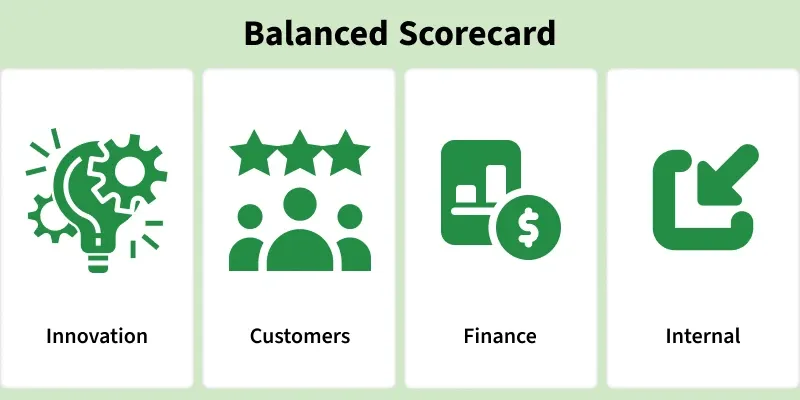
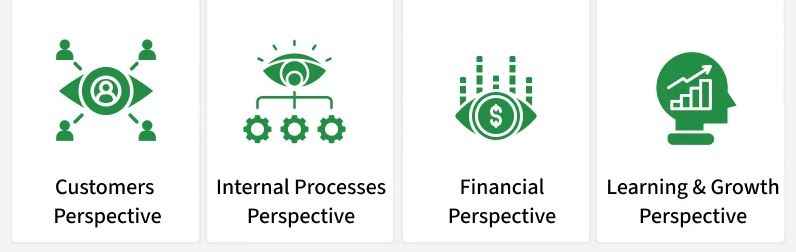
👁 balanced_scorecardThe concept of the Balanced Scorecard (BSC) consists of four distinct perspectives, each addressing specific objectives, measures, and targets:
Financial Perspective: This perspective focuses on financial metrics that serve as a common language for analyzing and comparing companies. Key indicators include growth, profit margin, return on investment, economic value added, and shareholder market value. By assessing financial performance, organisations gain insights into their profitability, sustainability, and overall financial health.
Customer Perspective: The customer perspective recognizes the importance of understanding and meeting customer needs and expectations. Key indicators in this perspective include customer satisfaction, retention, market share, and customer profitability. By prioritizing customer value and satisfaction, organisations can drive revenue growth and gain a competitive edge.
Internal Process Perspective: This perspective focuses on the internal processes and operations that contribute to the delivery of high-quality products or services. By optimizing these processes, organisations can enhance efficiency, reduce costs, and improve overall performance. Key objectives in this perspective include process improvement, cycle time reduction, quality performance, productivity enhancement, and effective after-sales service.
Learning and Growth Perspective: It acknowledges the vital role of human resources and organisational culture in driving innovation and continuous improvement. This perspective recognizes that learning goes beyond formal training and encourages managers to act as coaches, fostering collaboration, knowledge sharing, and problem-solving among employees.
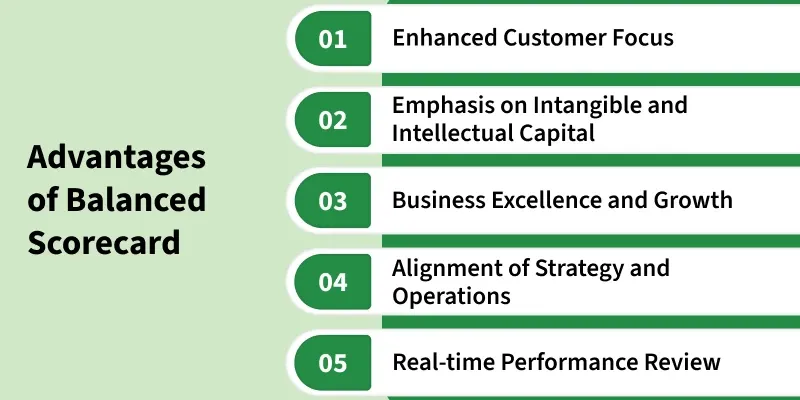
The Balanced Scorecard (BSC) offers significant benefits and advantages for organisations. Some of these advantages are:
Enhanced Customer Focus: In today's competitive landscape, companies are increasingly recognizing the importance of being customer-centric. The BSC helps organisations gain a comprehensive understanding of their target customers, their needs, and how to deliver value that delights them. By incorporating customer-focused metrics and initiatives, companies can improve customer satisfaction and gain a competitive edge.
Emphasis on Intangible and Intellectual Capital: Traditional financial measures alone do not capture the full value of an organisation. The BSC encourages companies to consider non-financial aspects such as brand equity, research and development, IT infrastructure, and marketing systems. By investing in these intangible assets and building intellectual capital, organisations can drive long-term profitability and growth.
Alignment of Strategy and Operations: One of the key strengths of the BSC is its ability to connect strategic objectives with day-to-day operations. By cascading strategic goals down to individual tasks and actions, employees understand how their work contributes to the overall organisational objectives. This alignment improves employee engagement, accountability, and ultimately, organisational performance.
Real-time Performance Review: The BSC serves as a dynamic performance tracking system, enabling real-time monitoring and review. Organisations can establish robust information systems linked to the scorecard, allowing them to track and analyze performance data in real time. This timely feedback and review process enables organisations to identify areas for improvement and make informed decisions promptly.
To ensure the successful implementation of the Balanced Scorecard, the following conditions are necessary:
Strong Commitment and Support from Top Management: Successful implementation of the Balanced Scorecard requires full commitment from top management. Their active support ensures clear direction, resource allocation, and organization-wide acceptance.
Identification of Critical Success Factors (CSFs): Organizations must identify the key factors that are essential for achieving strategic success. These CSFs should reflect stakeholder needs, including customers, employees, society, and government.
Translation of CSFs into Measurable Objectives (Metrics): CSFs must be converted into clear, measurable performance indicators to track progress effectively. These metrics should align with strategy, be objective, actionable, and regularly reviewed.
Integration of Performance Measures with Rewards: Performance measurement should be linked with a reward system to motivate employees. This alignment encourages individuals to focus on achieving strategic goals and improving performance.
Implementation of an Effective Tracking System: A strong tracking system is necessary to monitor performance continuously and provide timely feedback. It supports learning, identifies gaps, and ensures ongoing improvement in organizational performance.