|
VOOZH | about |
|
VOOZH | about |
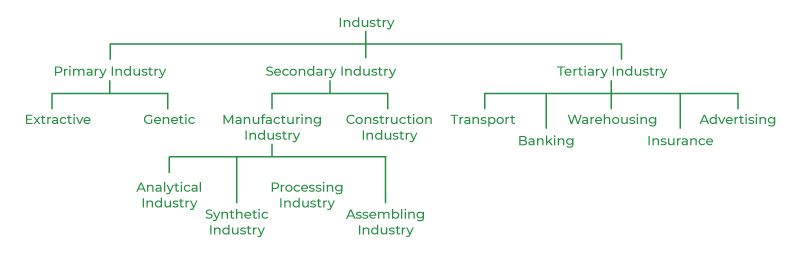
The industry is concerned with the processing and production of goods and services with the motive of earning profit. In simple words, it involves changing the raw materials into finished products for the purpose of selling them to the customers. The goods sold by industry can be either used by other companies for further production or can be used by the end consumers for final consumption. The goods produced in the former case are known as producer goods. For example, machinery, tools, etc. However, the goods produced in the latter case are known as consumer goods. For example, bread, milk, butter, cloth, groceries, medicines, etc. An organization can also produce materials that can be used by other companies to further process and convert them into finished goods. These goods are known as intermediate goods. For example, rubber, copper, plastic, etc. Industry can be further classified into three parts: primary, secondary, and tertiary industry.
👁 ImageTable of Content
The primary industry involves the extraction of raw materials or natural resources from the earth and the reproduction of living organisms. The economic operations of a business under the primary sector usually depend on the nature of a specific place where the extraction or reproduction is being done. Therefore, we can say that the economic operations of a primary industry revolve around the natural resources available on earth. The primary industries produce or create products that are sold to the public. For example, farming, mining, fishing, forestry, agriculture, crop production, animal husbandry, etc. The primary sector of less advanced economies and includes activities or businesses from these areas. As a country develops, it becomes less dependent on primary industry and more on secondary and tertiary. Some of the workers in the primary industry are hunters, farmers, coal miners, etc.
Primary industry is further divided into two categories:
The secondary industry uses the raw materials extracted in the primary sector and then converts them into the finished product. Therefore, the secondary industry consists of construction and manufacturing industries. The products manufactured under secondary industries are either consumed by the end customer or used as raw material by other industries for further processing or production. For example, getting wood from forests is a primary industry; however, making furniture from wood is a secondary industry. The businesses under secondary industry usually use massive machinery in their production plants for manufacturing goods and even use human resources for packaging and distribution of goods to retailers, wholesalers, etc., at different locations.
Secondary industry is further divided into two categories: Manufacturing and Construction Industry.
These are the industries that are involved in the process of converting raw materials or semi-finished products into finished products. Manufacturing industries create form utility as it changes the form of raw materials into finished goods. For example, cotton is a raw material that is converted in clothes under the manufacturing industry, iron is converted into benches, sugarcane into sugar, wheat into bread, etc.
The two types of goods produced in the manufacturing industry are:
The manufacturing industry is further divided into four categories:
These are the industries that are involved with the construction of roads, dams, buildings, etc., for the development of an economy. The construction industry use products of the manufacturing industry, such as steel, iron, cement, etc. The products of construction industries are unique in a way that their products cannot be moved or transferred from one place to another. For example, a dam can be built at a fixed place and cannot be moved as per the choice of anyone.
The tertiary industry involves providing services and facilitating a smooth flow of goods and services in the market. The tertiary industry is also known as the service industry, and it helps the primary and secondary industries with their activities. It means that the tertiary industry provides services to different primary and secondary industries to support their activities.
Different types of services provided by the service industry are: