|
VOOZH | about |
|
VOOZH | about |
The Stars and Bars (also known as Balls and Urns) technique is a widely used method in Combinatorics, which is the branch of mathematics dealing with counting and arrangements.
The core idea of the Stars and Bars method is both simple and powerful.
To divide the objects into groups, We choose positions of (k − 1) bars among (n + k − 1) total positions.
Formula: The number of ways to distribute n identical objects into k distinct groups (where groups can be empty) is given by:
Where:
- C(n, r) represents the binomial coefficient
- It is defined as:
We need to place (k − 1) bars among n stars to divide them into k groups. Thus, the problem reduces to choosing positions for the bars from a total of (n + k − 1) positions.
The Stars and Bars technique has two important variations depending on constraints:
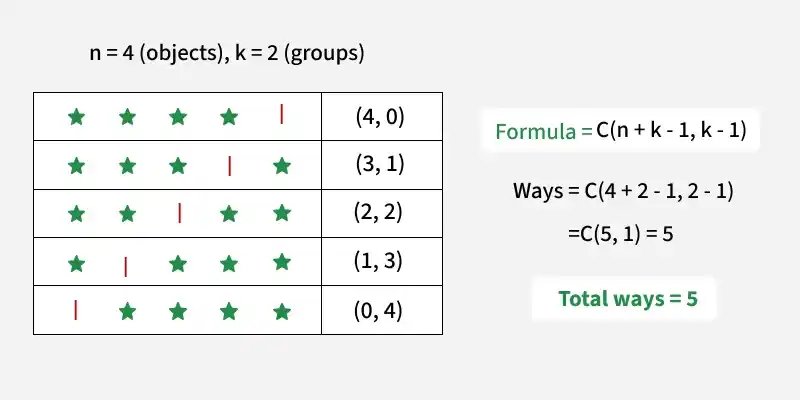
Consider that we have n identical objects (represented as stars) and we want to distribute them into k distinct groups. Each group is allowed to have zero or more objects. According to the Stars and Bars theorem, the number of ways to perform this distribution is: , where C(n, r) denotes the binomial coefficient.
Example:
5
Time Complexity: O(k), where k is the number of groups among which objects are distributed.
Auxiliary Space: O(1)
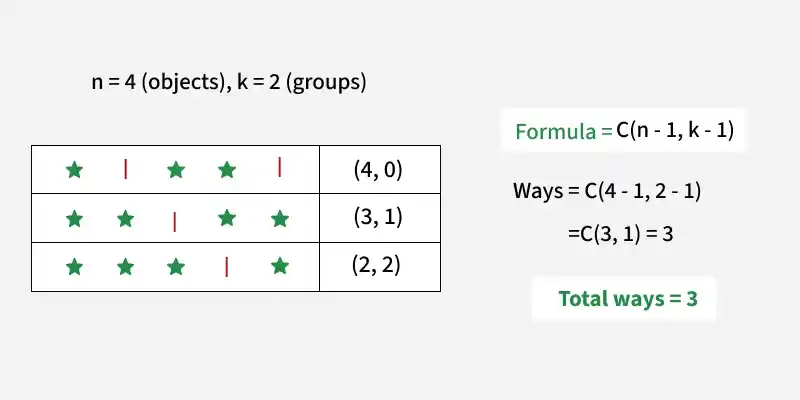
Consider that we have n identical objects (represented as stars) and we want to distribute them into k distinct groups such that each group must contain at least one object. According to the Stars and Bars theorem, the number of ways to distribute the objects is: , where C(n, r) denotes the binomial coefficient.
Example:
3
Time Complexity: O(k), where k is the number of groups among which objects are distributed.
Auxiliary Space: O(1)
Real Life Applications of Stars and Bars:
Related Article: