Wireless networking technology that enables devices to connect to a local network and the Internet using radio waves instead of cables is known as Wi-Fi.
Uses radio waves instead of physical cables for data transmission.
Based on IEEE 802.11 standards.
Enables wireless local area networks (WLAN) using access points.
Supports devices like laptops, smartphones, and tablets.
Operates at the Physical and Data Link layers of the OSI model.
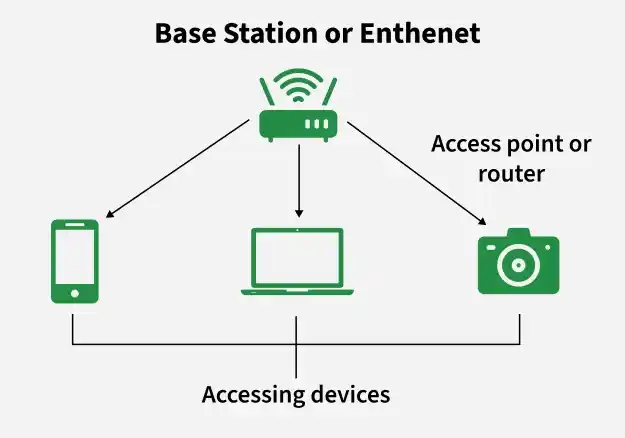
👁 base_station_or_enth Wireless access point connecting multiple devices such as smartphones, laptops, and cameras to a network.
Access Point (AP)
Acts as a wireless LAN base station that connects wireless devices to a wired network, typically the Internet, using an Access Point (AP).
Acts as a central transmitter and receiver for wireless devices
Known for fundamental building block of a wireless LAN.
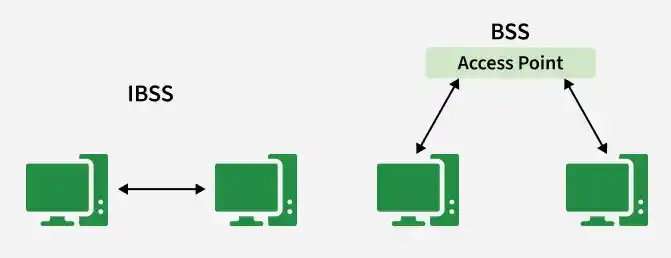
Types of BSS:
1.1 Infrastructure BSS
Includes one access point
Wireless devices communicate through the AP
Can exchange data with other BSSs
2.2 Independent BSS (IBSS) / Ad-hoc Network
No access point is present
Devices communicate directly with each other
Cannot communicate with other BSSs
Suitable for small, temporary networks
👁 419253544 IBSS (ad hoc) vs BSS (infrastructure) Wi-Fi communication.
2. Extended Service Set (ESS)
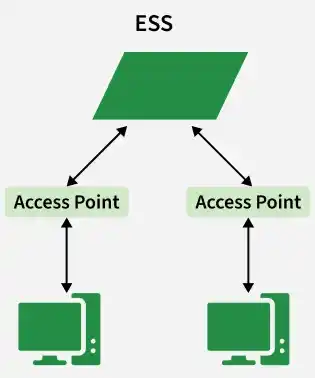
Formed by connecting two or more Basic Service Sets (BSSs) through a distribution system like Ethernet, this arrangement is known as an Extended Service Set (ESS).
Multiple BSSs are interconnected
Each BSS has its own access point
Allows seamless roaming between BSSs
Used in large networks like campuses and offices
Types of Stations in ESS
Mobile Stations: Wireless devices within a BSS
Stationary Stations: Access points connected to the wired LAN
👁 419253546 ESS with multiple access points for wider coverage.
Features of Wi-Fi
Wireless Connectivity: Allows devices to connect without physical cables, providing mobility and flexibility.
High Speed: Supports fast data transfer rates suitable for streaming, browsing, and file sharing.
Easy Setup: Simple to install and configure; most modern devices have built-in Wi-Fi support.
Multiple Device Support: Enables multiple users and devices to connect simultaneously to the same network.
Security: Uses encryption methods such as WPA and WPA2 to protect data from unauthorized access.
Range: Coverage depends on router power, environmental conditions, and physical obstacles.
Compatibility: Works with a wide range of devices including smartphones, laptops, tablets, and smart home devices.
Interference: Performance may be affected by other wireless devices and physical barriers.
Reliability: Network speed and stability can decrease due to congestion or weak signal strength.