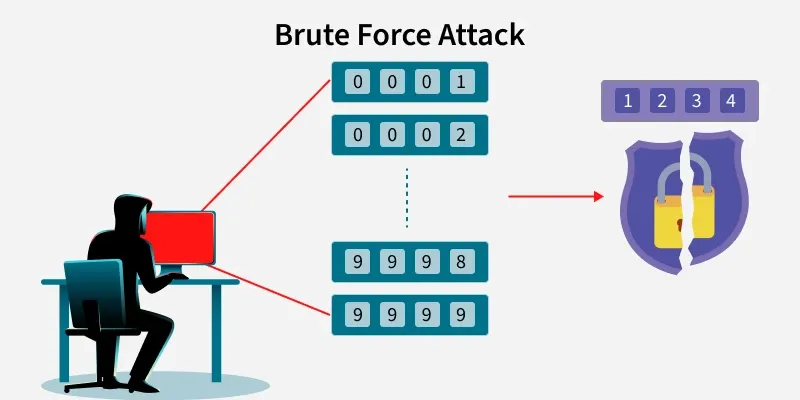
Brute force is a method where attackers try all possible passwords until the right one is found. It doesn’t exploit software flaws but relies on trial-and-error testing. The attack may use common wordlists (dictionary) or full character sets. Though slow, weak passwords can be cracked quickly with powerful systems.
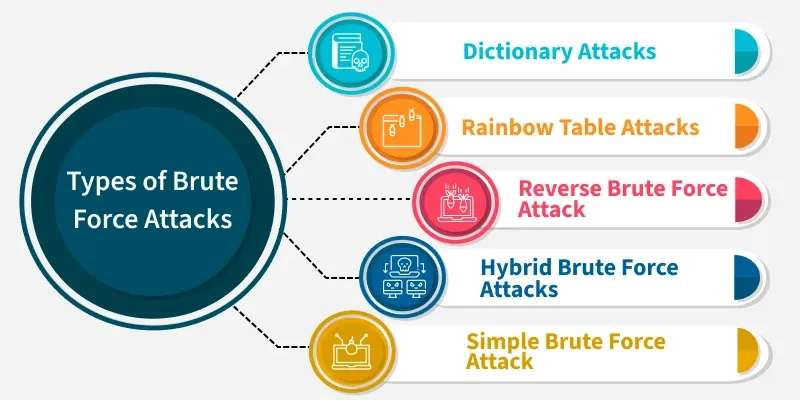
Dictionary Attacks: Attempts to guess usernames or passwords by using a predefined dictionary of likely words or phrases
Rainbow Table Attacks: A Rainbow Table is a precomputed database used to reverse cryptographic hash functions. It helps quickly find the original input from a hash, but only works for inputs up to a certain length and within a limited character set.
Reverse Brute Force Attack: It utilizes a typical password or a collection of passwords against numerous conceivable usernames. Focuses on a network of clients for which the attackers have recently acquired information.
Hybrid Brute Force Attacks: It begins from outer rationale to figure out which password variety might be destined to succeed, and next proceeds with the simple way to deal with attempt numerous potential varieties.
Simple Brute Force Attack: Utilizes an efficient way to deal with 'surmise' that doesn't depend on outside reasoning.
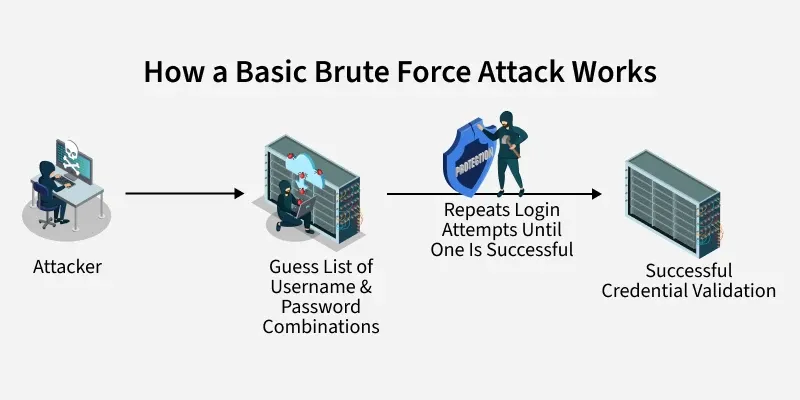
Brute Force Working
Here is the step-by-step process of how a brute force attack is done by attackers: