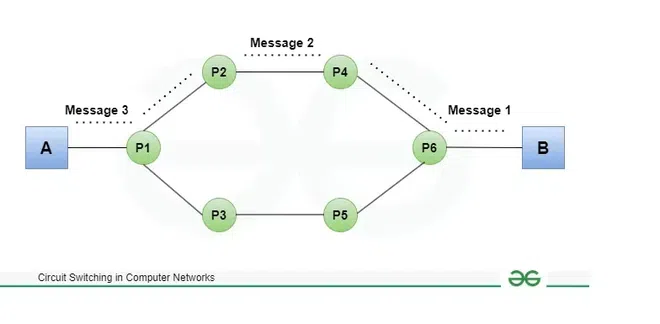
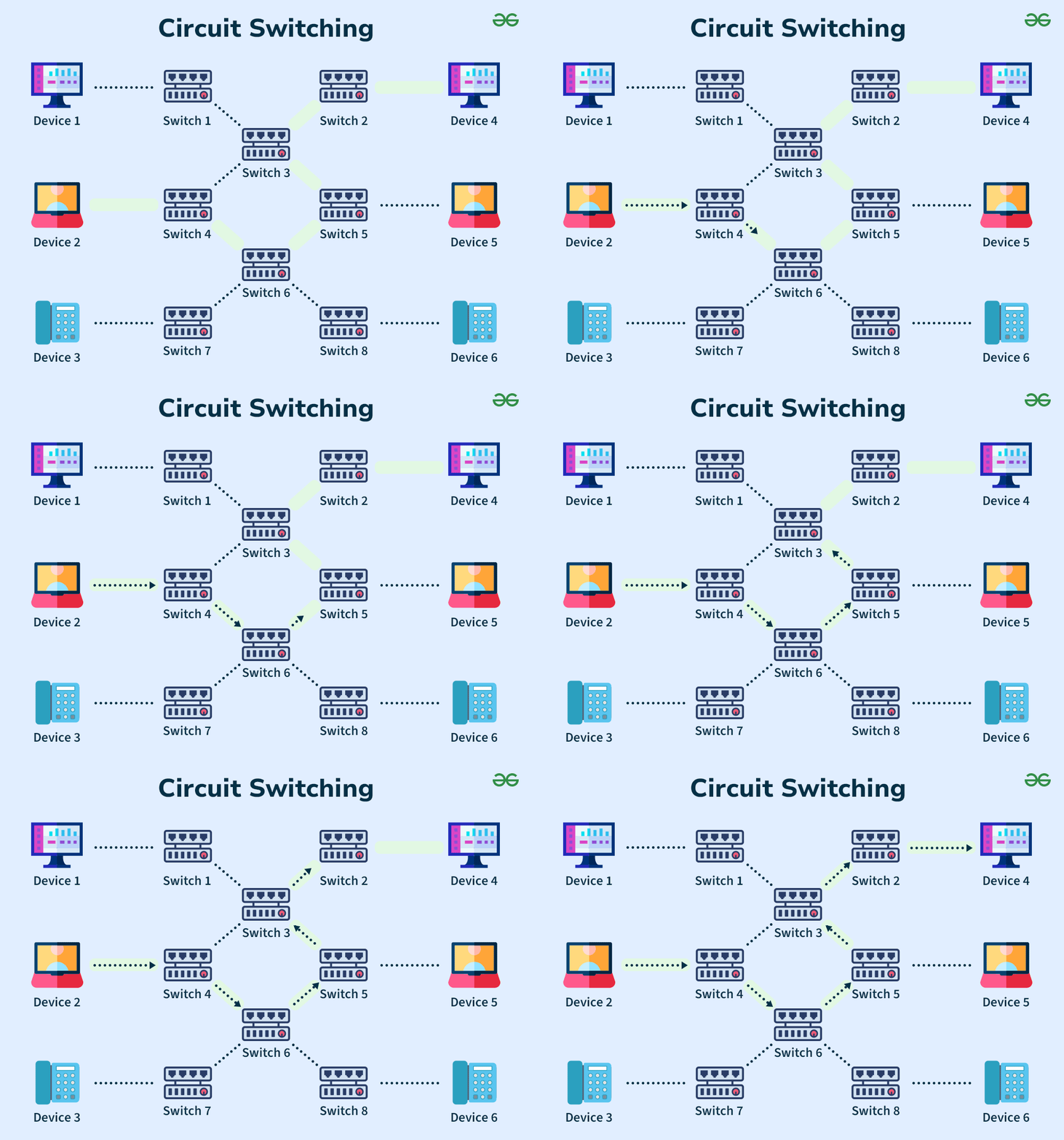
Circuit Switching establishes a dedicated path between sender and receiver before communication, using the full network bandwidth. Data flows without delay, and bit delay remains constant. While it guarantees a fixed data rate, it is costly and inefficient for high-traffic or large networks due to reserved resources.
Bandwidth is divided into pieces.
Bit delay is constant during communication.
Data can flow without delay once the circuit is established.
The telephone system network is one of the examples of Circuit switching. FDM (Frequency Division Multiplexing) and TDM (Time Division Multiplexing) are two methods of multiplexing multiple signals into a single carrier.
1. Frequency Division Multiplexing (FDM):
Divides total bandwidth into non-overlapping frequency bands.
Each band carries a separate signal simultaneously.
Used in radio, TV, and optical fiber for multiple independent signals.
2. Time Division Multiplexing (TDM):
Transmits multiple signals over the same channel at different time slots.
Uses synchronized switches at both ends.
Suitable for long-distance links with heavy data traffic.
Also called a digital circuit switch
Phases of Circuit Switching
Circuit Establishment: A dedicated circuit between the source and destination is constructed via a number of intermediary switching center's. Communication signals can be requested and received when the sender and receiver communicate signals over the circuit.
Data Transfer: Data can be transferred between the source and destination once the circuit has been established. The link between the two parties remains as long as they communicate.
Circuit Disconnection: Disconnection in the circuit occurs when one of the users initiates the disconnect. When the disconnection occurs, all intermediary linkages between the sender and receiver are terminated.
1. Transmission rate = Link Rate or Bit rate / no. of slots = R/h bps
2. Transmission time = size of file / transmission rate = x / (R/h) = (x*h)/R second
3. Total time to send packet to destination = Transmission time + circuit setup time
4. Transmission rate from frames/sec and bits/slot:
Transmission Rate=F⋅B bits/sec
What is Circuit Switching Used For?
Continuous connections: Circuit switching is used for connections that must be maintained for long periods, such as long-distance communication. Circuit switching technology is used in traditional telephone systems.
Dial-up network connections: When a computer connects to the internet through a dial-up service, it uses the public switched network. Dial-up transmits Internet Protocol (IP) data packets via a circuit-switched telephone network.
Optical circuit switching: Data centre networks also make use of circuit switching. Optical circuit switching is used to expand traditional data centres and fulfil increasing bandwidth demands.
Advantages of Circuit Switching
Guaranteed data rate: Dedicated channel ensures consistent transmission speed.
No delay in data flow: Dedicated path allows continuous data transfer.
High reliability: Reserved path prevents data loss or corruption.
Quality of service (QoS): Supports prioritization of critical traffic like voice or video.
Disadvantages of Circuit Switching
Limited scalability: Not suitable for large networks; needs a dedicated path for each communication.
Vulnerable to failures: If a path fails, communication is disrupted.
Limited flexibility: Dedicated circuits cannot be used by others until communication ends.
Wastes resources: Bandwidth is reserved even when no data is sent.
High cost: Setting up and maintaining dedicated paths is expensive.