|
VOOZH | about |
|
VOOZH | about |
Pre-requisites: Difference between Static and Dynamic Routing
Routing is the process of establishing the routes that data packets must follow to reach the destination. In this process, a routing table is created which contains information regarding routes that data packets follow. Various routing algorithms are used for the purpose of deciding which route an incoming data packet needs to be transmitted on to reach the destination efficiently.
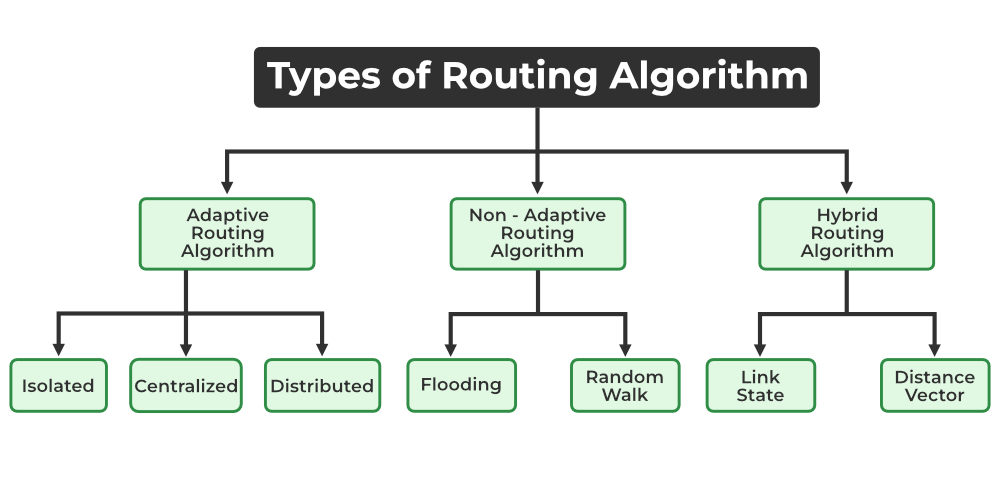
The routing algorithms can be classified as follows:
Routing algorithms can be classified into various types such as distance vector, link state, and hybrid routing algorithms. Each has its own strengths and weaknesses depending on the network structure.
These are the algorithms that change their routing decisions whenever network topology or traffic load changes. The changes in routing decisions are reflected in the topology as well as the traffic of the network. Also known as dynamic routing, these make use of dynamic information such as current topology, load, delay, etc. to select routes. Optimization parameters are distance, number of hops, and estimated transit time.
Further, these are classified as follows:
These are the algorithms that do not change their routing decisions once they have been selected. This is also known as static routing as a route to be taken is computed in advance and downloaded to routers when a router is booted.
Further, these are classified as follows:
As the name suggests, these algorithms are a combination of both adaptive and non-adaptive algorithms. In this approach, the network is divided into several regions, and each region uses a different algorithm.
Further, these are classified as follows:
The main difference between Adaptive and Non-Adaptive Algorithms is:
Adaptive Algorithms are the algorithms that change their routing decisions whenever network topology or traffic load changes. It is called Dynamic Routing. Adaptive Algorithm is used in a large amount of data, highly complex network, and rerouting of data.
Non-Adaptive Algorithms are algorithms that do not change their routing decisions once they have been selected. It is also called static Routing. Non-Adaptive Algorithm is used in case of a small amount of data and a less complex network.
For more differences, you can refer to Differences between Adaptive and Non-Adaptive Routing Algorithms.
One of the earliest protocols developed is the inner gateway protocol, or RIP. we can use it with local area networks (LANs), that are linked computers in a short range, or wide area networks (WANs), which are telecom networks that cover a big range. Hop counts are used by the Routing Information Protocol (RIP) to calculate the shortest path between networks.
IGRP was developed by the multinational technology corporation Cisco. It makes use of many of the core features of RIP but raises the maximum number of supported hops to 100. It might therefore function better on larger networks. IGRPs are elegant and distance-vector protocols. In order to work, IGRP requires comparisons across indicators such as load, reliability, and network capacity. Additionally, this kind updates automatically when things change, such as the route. This aids in the prevention of routing loops, which are mistakes that result in an unending data transfer cycle.
Exterior gateway protocols, such as EGP, are helpful for transferring data or information between several gateway hosts in autonomous systems. In particular, it aids in giving routers the room they need to exchange data between domains, such as the internet.
This kind is categorised as a classless protocol, inner gateway, and distance vector routing. In order to maximise efficiency, it makes use of the diffusing update method and the dependable transport protocol. A router can use the tables of other routers to obtain information and store it for later use. Every router communicates with its neighbour when something changes so that everyone is aware of which data paths are active. It stops routers from miscommunicating with one another. The only external gateway protocol is called Border Gateway Protocol (BGP).
OSPF is an inner gateway, link state, and classless protocol that makes use of the shortest path first (SPF) algorithm to guarantee effective data transfer. Multiple databases containing topology tables and details about the network as a whole are maintained by it. The ads, which resemble reports, provide thorough explanations of the path's length and potential resource requirements. When topology changes, OSPF recalculates paths using the Dijkstra algorithm. In order to guarantee that its data is safe from modifications or network intrusions, it also employs authentication procedures. Using OSPF can be advantageous for both large and small network organisations because to its scalability features.
Another kind of outer gateway protocol that was first created to take the role of EGP is called BGP. It is also a distance vector protocol since it performs data package transfers using the best path selection technique. BGP defines communication over the internet. The internet is a vast network of interconnected autonomous systems. Every autonomous system has autonomous system number (ASN) that it receives by registering with the Internet Assigned Numbers Authority.
The difference between Routing and Flooding is listed below:
| Routing | Flooding |
|---|---|
| A routing table is required. | No Routing table is required. |
| May give the shortest path. | Always gives the shortest path. |
| Less Reliable. | More Reliable. |
| Traffic is less. | Traffic is high. |
| No duplicate packets. | Duplicate packets are present. |