|
VOOZH | about |
|
VOOZH | about |
In computer networks, Controlled Access Protocols (CAPs) manage how multiple devices share a common communication medium. These protocols control the right to transmit in such a way that collisions are avoided, efficiency is maintained, and fair access is ensured.
Note: Unlike random access methods (e.g., ALOHA, CSMA), in controlled access, stations do not transmit at will. Instead, they follow a systematic method to determine which station has the right to send at a given time.
In Controlled Access, before transmitting data, a station must first obtain permission to access the channel. At any given time, only one node can send data, preventing collisions. This coordination is achieved using one of three methods:
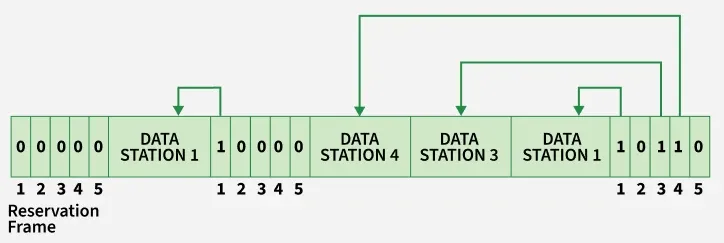
In this method, stations reserve slots in advance before transmission. The timeline has two parts:
Example: If there are M stations, the reservation interval is divided into M slots. Each station signals intent by inserting a bit into its slot. Then, only the reserved stations transmit in the data phase.
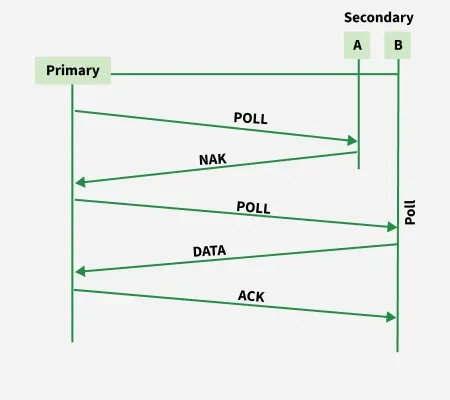
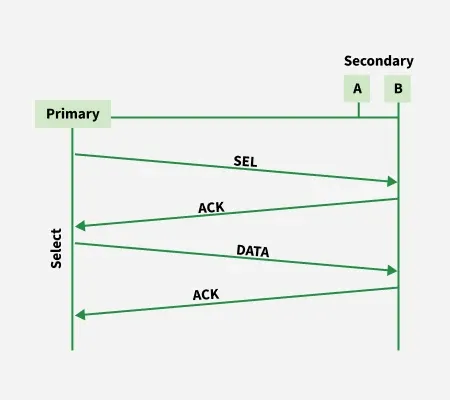
Here, a controller (primary station) polls each node (secondary station) in sequence, granting permission to send. The controller sends a message with the address of a station. The addressed station responds:
Advantages
where:
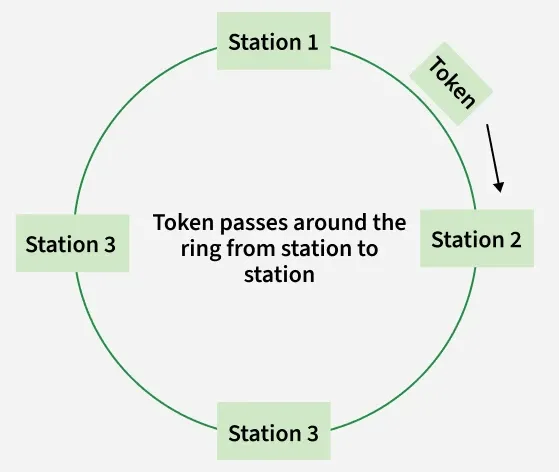
In Token Passing, stations are logically connected (ring or bus). A special frame called a token circulates among stations:
1. For a<1a < 1a<1:
2. For a>1a > 1a>1:
where:
| Feature | Reservation | Polling | Token Passing |
|---|---|---|---|
| Access Control | Slot-based reservation | Central controller polls | Token circulation |
| Efficiency | High (under heavy load) | Moderate (polling overhead) | High (predictable) |
| Collision Chance | None | None | None |
| Overhead | Reservation slots | Polling messages | Token management |
| Best For | Real-time multimedia | Small/medium networks | Large/high-load networks |