VOOZH about

URL: https://www.geeksforgeeks.org/computer-networks/difference-between-analog-communication-and-digital-communication/

⇱ Analog and Digital Communication - GeeksforGeeks


  • Courses
  • Tutorials
  • Interview Prep

Analog and Digital Communication

Last Updated : 25 Sep, 2025

Communication systems are broadly classified into two types: analog communication and digital communication. Both methods are used to transfer information, but they differ in how signals are represented and transmitted.

1. Analog Communication

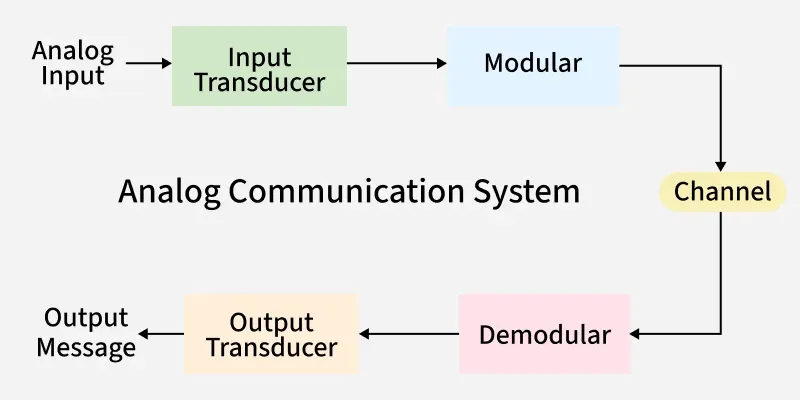
In Analog communication the data is transferred with the help of analog signal in between transmitter and receiver. Here, information is transmitted using a continuous signal.

  • The signal varies with respect to parameters such as amplitude, frequency, or phase.
  • Voice, video, or data are converted into continuous electrical signals first and then sent through a communication channel.
  • Example: Radio broadcasting, television transmission, and telephone systems.

Advantages of Analog Signals

  • It is Easier in processing.
  • Analog Signals are best fitted to audio and video transmission.
  • It has a coffee cost and is portable.
  • It posses higher density.

Disadvantages of Analog Signals

  • Analog tends to possess a lower quality signal than digital.
  • The cables are sensitive to external influences.
  • Analog wire is expensive and not easily portable.
👁 Analog-Communication-System
Analog Communication

2. Digital Communication

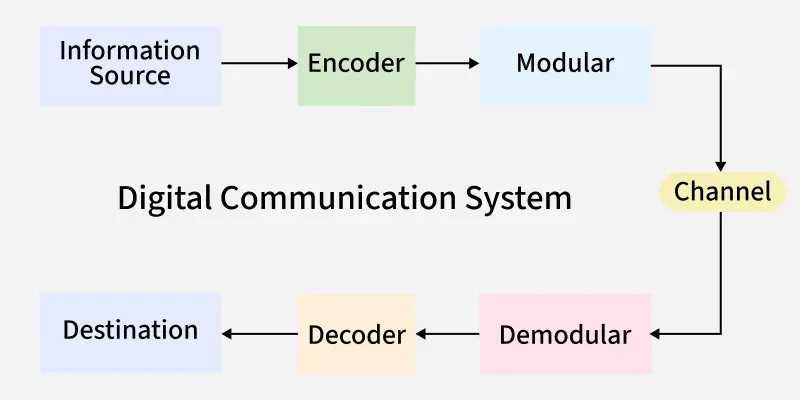
In Digital communication digital signal is used rather than analog signal for communication in between the source and destination. The digital signal consists of discrete values (0 and 1) rather than continuous values

  • Data is transferred as a digital bit stream over a transmission medium.
  • Information can be divided into packets and sent as discrete messages.
  • Example: Computer networks, mobile communication, and digital television.

Advantages of Digital Communication

  • The speed of data transmission is quite high therefore, message transfer occurs almost instantly.
  • The process of digital communication is quite efficient because speed and accuracy are always maintained in this system.
  • The wireless nature of digital communication can be used to establish connections globally without major geographical constraints.

Disadvantages of Digital Communication

  • Digital Communication lacks a personal touch due to a lack of proper interaction between users at both the ends of channel.
  • With an increase in network coverage, the complexity of digital communication systems increases and therefore, implementation of such circuits is difficult.
👁 Digital-Communication-System
Digital Communication

Difference between Analog Communication and Digital Communication

         ANALOG COMMUNICATION            DIGITAL COMMUNICATION
Analog communication uses analog signal whose amplitude varies continuously with time from 0 to 100.Digital communication uses digital signal whose amplitude is of two levels either Low i.e., 0 or either High i.e., 1.
It gets affected by noise highly during transmission through communication channel.It gets affected by noise less during transmission through communication channel.
Only limited number of channels can be broadcasted simultaneously.It can broadcast large number of channels simultaneously.
Error Probability is high.Error Probability is low.
Noise immunity is poor.Noise immunity is good.
Coding is not possible.Coding is possible and different coding techniques can be used to detect and correct errors.
Separating out noise and signal in analog communication is not possible.Separating out noise and signal in digital communication is possible.
Have complex hardware and less flexible.Have less complex hardware and more flexible.
Frequency Division Multiplexing (FDM) is used for multiplexing.Time Division Multiplexing (TDM) is used for multiplexing.
Cost efficientCostly
It requires low bandwidth.It requires high bandwidth.
Power consumption is high.Power consumption is low.
Comment
Article Tags:

Explore