|
VOOZH | about |
|
VOOZH | about |
Transferring data between two devices is known as Transmission Mode. It is also known as Communication Mode. Now we are going to discuss Simplex Mode, Half Duplex Mode and Full Duplex Mode in detail.
We design networks and buses to allow communication between devices. There are 3 types of transmission modes which are given below:
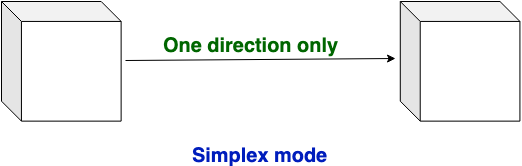
In simplex mode, Sender can send the data but the sender unable receive the data. It is a type of on way communication in which communication happens in only one direction. Example of this kind of mode is Keyboard, Traditional Monitors, etc.
In half-duplex mode, Sender can send the data and also receive the data one sequentially. It is a bidirectional communication but limited to only one at a time. An example of this is the Walkie-Talkie, in which information is sent one at a time but in bi-directions.
Half-duplex mode is a balance between simplex and full-duplex modes, providing dual communication but with some compromises in speed and performance.
1. Efficient Use of Channel: Half-duplex allows for bidirectional communication over a single channel, making it effective for scenarios where parallel transmission isn't required.
2. Cost-Effective: It requires less complicated and less costly hardware than full-duplex systems, as only one device conveys at a time.
3. Simplified Collision Handling: Since only one device can transmit at a time, crashes are reduced, reducing the need for complicated collision detection and management protocols.
4. Suitable for Periodic Communication: Optimal for situations where communication doesn't need to happen concurrently in both directions, such as walkie-talkies or specific network protocols.
1. Slower Data Transmission: Since data can only run in one direction at a time, communication is naturally delayed compared to full-duplex systems where data can be delivered and received simultaneously.
2. Increased Latency: The need to exchange between sending and receiving modes introduces delay, which can affect performance in congestion applications.
3. Not Ideal for High-Traffic Networks: In networks with congestion or applications requiring constant communication, half-duplex mode can become a restriction.
4. Inefficient for Complex Communications: For tasks that require frequent two way communication, half-duplex can be less effective as it forces devices to wait their turn, which can lead to pauses.
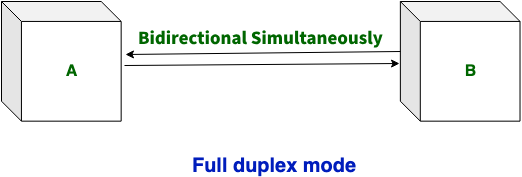
In Full-duplex mode, Sender can send the data and also can receive the data simultaneously. It is dual way communication that is both way of communication happens at a same time. Example of this kind of transmission is Telephone Network, where communication happens parallel.
For more detailed description of these topics, refer to Transmission Mode in Computer Networks.
| Parameters | Simplex | Half Duplex | Full Duplex |
|---|---|---|---|
| The direction of communication | Simplex mode is a uni-directional communication. | Half Duplex mode is a dual directional communication but one at a time. | Full Duplex mode is a two-way directional communication simultaneously. |
| Sender and Receiver | In simplex mode, sender can send the data but that sender can't receive the data. | In Half Duplex mode, sender can send the data and also can receive the data but one at a time. | In Full Duplex mode, sender can send the data and also can receive the data simultaneously. |
| Channel usage | Usage of one channel for the transmission of data. | Usage of one channel for the transmission of data. | Usage of two channels for the transmission of data. |
| Performance | The simplex mode provides less performance than half duplex and full duplex. | The Half Duplex mode provides less performance than full duplex. | Full Duplex provides better performance than simplex and half duplex mode. |
| Bandwidth Utilization | Simplex utilizes the maximum of a single bandwidth. | The Half-Duplex involves lesser utilization of single bandwidth at the time of transmission. | The Full-Duplex doubles the utilization of transmission bandwidth. |
| Suitable for | It is suitable for those transmissions when there is requirement of full bandwidth for delivering data. | It is suitable for those transmissions when there is requirement of sending data in both directions, but not at the same time. | It is suitable for those transmissions when there is requirement of sending and receiving data simultaneously in both directions. |
| Examples | Example of simplex mode are: Keyboard and monitor. | Example of half duplex mode is: Walkie-Talkies. | Example of full duplex mode is: Telephone. |