|
VOOZH | about |
|
VOOZH | about |
Time Division Multiplexing is a technique in digital communication that deals with the transmission of several streams of data over a single communication channel. Mainly, there are two categories of TDM: Synchronous TDM and Asynchronous TDM, often referred to as Statistical TDM. Understanding these two concepts is important for optimization in the efficiency of data transmission in various applications, including telecommunications and networking.
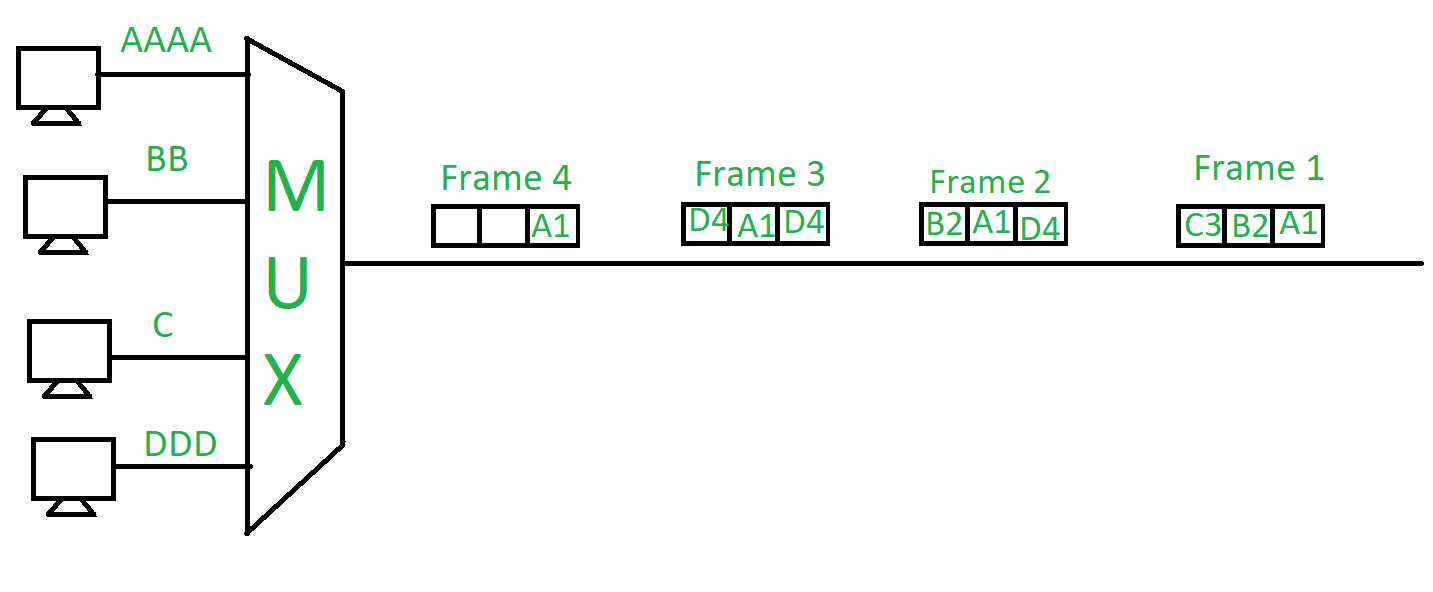
In synchronous TDM, every device which is present in this has given the same time slot to transmit data. It does not consider whether the device contains data or not. The devices place their data on the link when their time slots arrive, if somehow any device does not contain data its time-slot remains empty. There are various kinds of time slots that are organized into frames and each frame consist of one or more time slots dedicated to each sending device.
The asynchronous time division multiplexing, which is also called statistical TDM, allocates the time slots dynamically to the data streams based on requirements. In such types of multiplexing, the time slot is assigned only when the data stream has some information to be sent, making it more flexible.
Feature | Synchronous TDM | Asynchronous TDM (Statistical TDM) |
|---|---|---|
Time Slot Allocation | Fixed time slots pre-assigned to each data stream | Time slots are dynamically assigned based on demand |
Bandwidth Utilization | Inefficient; unused slots lead to bandwidth wastage | Efficient; slots are only used when data is present |
Data Transmission | Consistent, regardless of whether data is available | Transmits only when data is ready to be sent |
Suitability | Ideal for continuous, predictable data streams | Suitable for bursty or irregular data transmission |
Latency | Predictable latency due to fixed slots | Latency may vary based on demand and slot availability |
Complexity | Simpler to implement with pre-determined slots | More complex due to dynamic slot assignment |
Synchronization | Easier to synchronize due to fixed time slots | Harder to synchronize with dynamic allocation |
Cost Efficiency | Less cost-efficient due to potential unused slots | More cost-efficient, as resources are allocated on demand |
Synchronous and Asynchronous TDM both solve different problems related to multiplexing. Synchronous TDM would guarantee predictable, fixed time slot allocation, suitable for streams of data that come on a regular basis. Asynchronous TDM is more dynamic, adjusting to the amount of data at any given time that needs to be transmitted; because of this feature, this kind of TDM is suitable in applications with changing rates of data transmission.