|
VOOZH | about |
|
VOOZH | about |
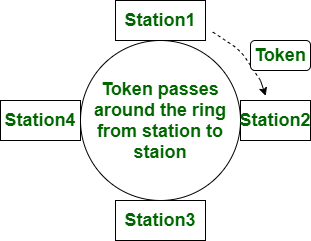
Token Ring is a LAN technology defined by the IEEE 802.5 standard. Devices are typically connected in a physical star topology through a Multistation Access Unit (MAU), while the network operates as a logical ring. A special control frame called a token circulates around the ring, and a device can transmit data only when it possesses the token. This controlled access method prevents data collisions and provides predictable network performance.
After transmitting its data, the device releases the token, allowing the next device in the logical ring to communicate. Token Ring networks also support priority mechanisms, enabling certain traffic to receive preferential access to the network when required.
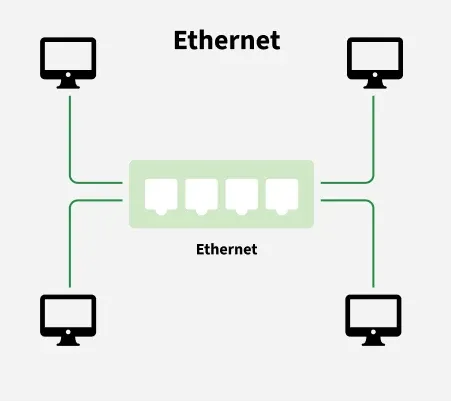
IEEE 802.3 defines the Ethernet. It uses CSMA/CD mechanism. It means that if many stations exist at the same time to talk, all stations will be closed. To resume them, wait for a random time. Unlike token ring it doesn't employ any priorities. It is less costly than token ring network.
| Feature | Token Ring | Ethernet |
|---|---|---|
| Access Method | Token passing mechanism. | CSMA/CD (Carrier Sense Multiple Access/Collision Detection). |
| IEEE Standard | IEEE 802.5. | IEEE 802.3. |
| Determinism | Deterministic. | Non-deterministic. |
| Topology | Star (logical ring). | Bus (traditionally), now often Star with switches. |
| Priority Handling | Supports priority handling. | Does not support priority natively. |
| Cost | More expensive. | Cheaper than Token Ring. |
| Cabling | Uses telephone wires. | Uses coaxial cables or twisted pair. |
| Routing Information | Contains routing information. | Does not contain routing information. |
| Speed | Slower (typically 4 Mbps to 16 Mbps). | Faster (10 Mbps to 100 Mbps or more). |
| Data Flow | Unidirectional (token must be received to send data). | Any device can transmit if the network is idle. |
| Active Workstations | Only one active at a time (token-based control). | Multiple can be active (collision management through CSMA/CD). |