Digital signatures and certificates are two fundamental technologies used to ensure security, authenticity, and trust in online communication.
Widely used in areas such as online banking, e-commerce, electronic document signing, etc.
Help to protect data from tampering, impersonation, and unauthorised access in digital environments.
Digital Signature
Cryptographic technique verifies authenticity, integrity, and non-repudiation of a digital message or document, ensuring known sender origin and protection against alteration during transmission.
Key Components of Digital Signature
1. Key Generation Algorithm
Digital signatures use asymmetric cryptography, which involves a pair of keys:
Private Key: Kept secret by the owner and used to create the signature.
Public Key: Shared with others and used to verify the signature.
This key pair ensures secure authentication during digital transactions.
2. Signing Algorithm
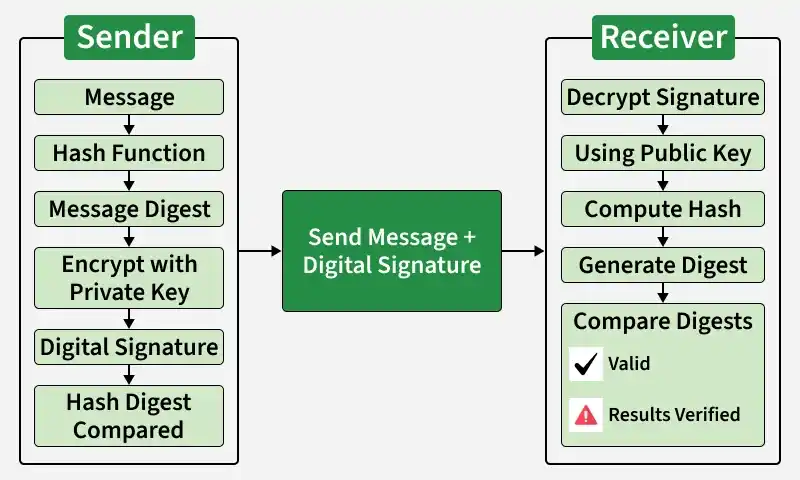
To create a digital signature:
A hash function generates a fixed-length message digest from the original message.
Digest is encrypted using sender's private key.
Encrypted value forms a digital signature.
Instead of encrypting the entire message, only the hash is encrypted because:
Hash values are much shorter.
Hashing is faster than encryption.
It improves efficiency without reducing security.
3. Signature Verification Algorithm
At the receiver’s side:
Digital signature is decrypted using sender public key to obtain original message digest.
Receiver independently computes hash of received message using same hash function.
Both hash values are compared; matching values confirm valid signature, while mismatch indicates compromised integrity.
User Trust: Browser-trusted certificates verify website legitimacy.
Data Encryption: Secures data during transmission.
Integrity: Ensures data is not altered.
Disadvantages
Phishing Risk: Fake websites can also obtain certificates.
Weak Encryption: Old certificates may use outdated algorithms.
Misconfiguration: Incorrect setup can create vulnerabilities.
Cost: Obtaining certificates may involve fees.
Expiry Issues: Certificates must be renewed regularly.
Digital Certificate vs Digital Signature
Feature
Digital Signature
Digital Certificate
Definition
Ensures the integrity and authenticity of a document
Verifies the identity of an entity
Purpose
Message verification
Identity verification
Generated By
Sender using private key
Certificate Authority
Standard
Digital Signature Standard (DSS)
X.509
Security Services
Integrity, authenticity, non-repudiation
Authentication and trust
Encryption and Decryption
Encryption is the process of converting plaintext into ciphertext to protect data from unauthorized access. Decryption is the process of converting ciphertext back into readable plaintext.
Types of Encryption
1. Symmetric Encryption: Use the same key for both encryption and decryption.
Faster than asymmetric encryption
Key must remain secret
Key distribution is difficult
2. Asymmetric Encryption: Use two different keys: a public key and a private key.
Public key is shared openly
Private key is kept secret
Used in digital signatures and certificates
Key Security Concepts
Public Key: Shared key used for encryption or verification.
Private Key: Secret key used for decryption or signing.
Authentication: Verifies the identity of the user or system.
Non-repudiation: Prevents the sender from denying an action.
Integrity: Ensures data remains unchanged.
Message Digest: Fixed-length hash value representing original data.
Digital Signature: Encrypting the message digest using the private key creates a digital signature for secure authentication.