|
VOOZH | about |
|
VOOZH | about |
In cryptography, it is a very monotonous task to distribute the public and private keys between sender and receiver. If the key is known to the third party (forger/eavesdropper) then the whole security mechanism becomes worthless. So, there comes the need to secure the exchange of keys. In this article, we will learn about key management, how Cryptographic Keys Work, Types of Key Management, and Key Management Lifecycle.
Key management refers to the processes and procedures involved in generating, storing, distributing, and managing cryptographic keys used in cryptographic algorithms to protect sensitive data. It ensures that keys used to protect sensitive data are kept safe from unauthorized access or loss. Good key management helps maintain the security of encrypted information and is important for protecting digital assets from cyber threats. Effective key management is crucial for ensuring the confidentiality, integrity, and availability of encrypted information by securing cryptographic keys from unauthorized access, loss, or compromise.
Cryptographic keys are special codes that protect information by locking (encrypting) and unlocking (decrypting) it. In symmetric key cryptography, a single shared key does both jobs, so the same key must be kept secret between users. In asymmetric key cryptography, there are two keys: a public key that anyone can use to encrypt messages or verify signatures, and a private key that only the owner uses to decrypt messages or create signatures. This makes it easier to share the public key openly while keeping the private key secret. These keys are crucial for secure communication, like when you visit a secure website (HTTPS), where they help encrypt your data and keep it safe from eavesdroppers and criminals. So, to manage these keys properly is vital to keep digital information secure and dependable.
There are two aspects of Key Management:
The public key can be distributed in four ways:
These are explained as following below:
1. Public Announcement: Here the public key is broadcast to everyone. The major weakness of this method is a forgery. Anyone can create a key claiming to be someone else and broadcast it. Until forgery is discovered can masquerade as claimed user.
👁 Public Key Announcement2. Publicly Available Directory: In this type, the public key is stored in a public directory. Directories are trusted here, with properties like Participant Registration, access and allow to modify values at any time, contains entries like {name, public-key}. Directories can be accessed electronically still vulnerable to forgery or tampering.
3. Public Key Authority: It is similar to the directory but, improves security by tightening control over the distribution of keys from the directory. It requires users to know the public key for the directory. Whenever the keys are needed, real-time access to the directory is made by the user to obtain any desired public key securely.
4. Public Certification: This time authority provides a certificate (which binds an identity to the public key) to allow key exchange without real-time access to the public authority each time. The certificate is accompanied by some other info such as period of validity, rights of use, etc. All of this content is signed by the private key of the certificate authority and it can be verified by anyone possessing the authority's public key.
First sender and receiver both request CA for a certificate which contains a public key and other information and then they can exchange these certificates and can start communication.
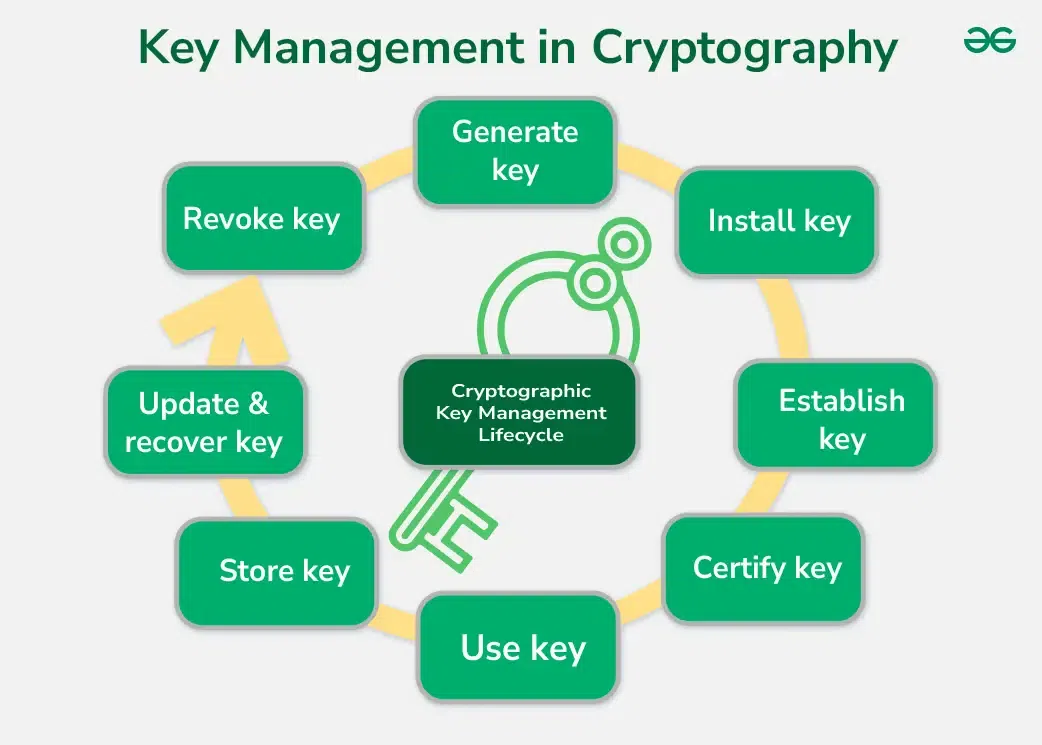
The key management lifecycle outlines the stages through which cryptographic keys are generated, used, and eventually retired or destroyed. Proper management of these keys is critical to ensuring the security of cryptographic systems. Here’s an overview of each stage:
1. Key Generation:
2. Key Distribution:
3. Key Storage:
4. Key Usage:
5. Key Rotation:
6. Key Revocation:
7. Key Archival:
8. Key Destruction:
Managing cryptographic keys is crucial for keeping data secure. It involves creating, distributing, storing, using, updating, and eventually destroying keys properly. Good key management ensures that keys are safe from unauthorized access and can be trusted throughout their life. By doing this, organizations protect sensitive information and maintain the security of their digital communications. In short, effective key management is essential for making encryption work and keeping information systems secure.