|
VOOZH | about |
|
VOOZH | about |
Network Designing is a process of placing the network devices (currently in use or to be used in the future) in such a manner that it follows all the Structured Engineering Principles which include Hierarchy, Modularity, Resiliency, and Flexibility. This Network Design often depends on the network size and requirements which are a critical factors for the successful implementation of any network.
According to the above Structured Engineering Principles, a network design must be based on a Hierarchical model which allows both Flexibility and Resiliency.
Hierarchical Network Design is now considered to be the best practice industry-wide to design networks that are reliable, resilient, scalable, and also cost-effective. Initially, networks were designed in a Flat Topology where the end devices were connected using Hubs and Switches. In order to add more devices or more users, more Switches/Hubs were added to the network. This Flat network design would cause a delay in the network if in case the network grows and also because of the use of Hubs and Switches it would be very difficult for the admins to control and limit the broadcast traffic or filter the undesired traffic in the network.
Because of the above limitations of the Flat Network Design, a Hierarchical Network Design Model was introduced. In a Hierarchical model, the network is divided into distinct layers. These layers (also known as Tiers) are connected with one another in the form of a hierarchy which enables the network to be divided into more manageable blocks and these blocks limit the local traffic to remain local even if it is broadcast traffic. A hierarchical Model can be applied for both LAN and WAN Network design.
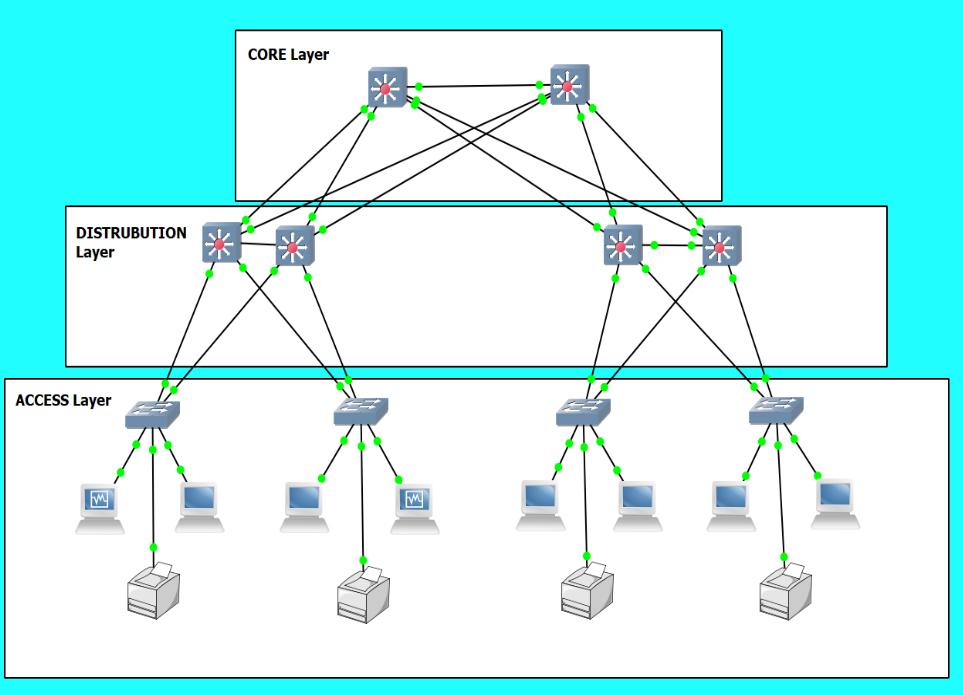
As you can see, a typical 3-Tier Hierarchical Network Design Topology consists of three layers:
This layer consists of end devices (end-users, local servers, etc.) that have local access to the network.
This layer basically provides policy-based connectivity and acts as a boundary between the Access Layer and the Core Layer. Data Filtering and Routing take place in this layer.
This layer is often considered to be the Backbone of the network which provides fast transport between the switches present in the Distribution Layer of the network. The Core Layer is considered to be the Backbone of the network and acts as an aggregation point for multiple networks.
This 3-Tier Hierarchical Network Design maximizes performance, scalability, and network availability and minimizes costs. However, Small Scale Enterprise Networks are not large enough, and therefore they use 2-Tier Hierarchical Network Design a.k.a. Collapsed Core Networks.
A Collapsed Core is when the functions of the Distribution Layer and the Core Layer are implemented by a single device. This type of Network Design is used by Small Scale Enterprises to implement their networks as their network is not large enough, and they might be unable to bear the high cost of the network devices. Therefore, these Enterprises use the Collapsed Core Topology Network Design (2-Tier Hierarchical Network Design) to reduce the network cost while maintaining most of the benefits, functions, and services offered by the 3-Tier Networks.