|
VOOZH | about |
|
VOOZH | about |
Hyperledger Fabric is an open-source platform for building distributed ledger solutions, with a modular architecture that delivers high degrees of confidentiality, flexibility, resiliency, and scalability. This enables solutions developed with fabric to be adapted for any industry. This is a private and confidential blockchain framework managed by the Linux Foundation. The article focuses on discussing Hyperledger Fabric in Blockchain. The following topics will be discussed here:
Hyperledger Fabric is designed for use in enterprise-level applications, and it is characterized by its modular architecture, permissioned network, and smart contract functionality, known as "chaincode".
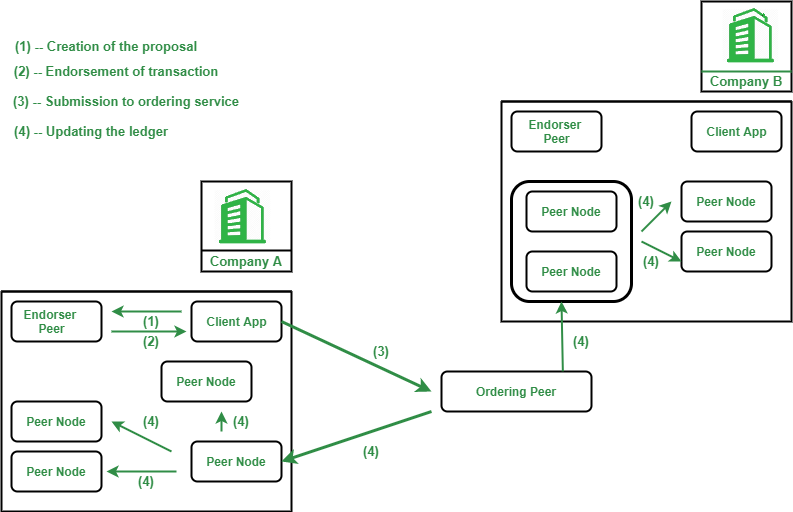
For each and every transaction in the fabric, the following steps are followed-
👁 Workflow of Hyperledger Fabric
Hyperledger Fabric uses a consensus algorithm to achieve agreement among the participants in a network on the contents of the shared ledger. The consensus algorithm in Hyperledger Fabric is pluggable, which means that it can be replaced with a different algorithm as needed.
The most commonly used consensus algorithms in Hyperledger Fabric are:
1. Supply Chain: Supply chains are global or regional webs of suppliers, manufacturers, and retailers of a particular product. Hyperledger Fabric networks can improve the transaction processes of the supply chain by increasing the clarity and traceability of transactions within the fabric. On a Fabric network, enterprises having authentication to access the ledger can view the data of the previous transactions. This fact increases accountability and reduces the risk of counterfeiting of the transactions. Real-time production and shipping updates can be updated to the ledger. Which can help us to track the product condition in a much faster, simpler, and efficient way.
2. Trading and Asset Transfer: Trading and asset transfer requires many organizations or members like importers, exporters, banks, brokers. They work with one another. And even in the era of digitalization a lot of paperwork is going on in this sector. But using Hyperledger they can transact and interact with each other in a paperless way. The Hyperledger fabric can add the same layer of trust as the document signed by a trusted authority. This also increases the performance of the system.
Another benefit of Hyperledger fabric is that assets can be dematerialized on the blockchain network with the help of Hyperledger fabric. Due to this traders or stakeholders will be able to have direct access to their financial securities and they can trade it anytime.
3. Insurance: The insurance industry spends billions to avoid insurance frauds or falsified claims. With the help of Hyperledger fabric, the Insurance company can refer to the transaction data that is stored inside the ledger. Hyperledger Fabric can also make the processing of claims faster using the chain code and automate the payment. This process will be also helpful for multi-party subrogation claims processing. Where it can automate repayment from the fault party back to the insurance company. Verification of identity or KYC process will be easy using this private blockchain.
1. Open Source: Hyperledger fabric is an open-source blockchain framework hosted by the Linux foundation. It has an active community of developers The code is designed to be publicly accessible. Anyone in the community can see, modify, and distribute the code as they see fit. People across the world can come and help to develop the source code.
2. Private and Confidential: In a public blockchain network each and every node in the network is receiving a copy of the whole ledger. Thus keeping privacy becomes a much bigger concern as everything is open to everyone. In addition to this one, the identities of all the participating members are not known and authenticated. Anyone can participate as it is a public blockchain. But in the case of Hyperledger fabric, the identities of all participating members are authenticated. And the ledger is only exposed to the authenticated members. This benefit is the most useful in industry-level cases, like banking, insurance, etc where customer data should be kept private.
3. Access Control: In the Hyperledger fabric, there is a virtual blockchain network on top of the physical blockchain network. It has its own access rules. It employs its own mechanism for transaction ordering and provides an additional layer of access control. It is especially useful when members want to limit the exposure of data and make it private. Such that it can be viewed by the related parties only. As an example when two competitors are on the same network. The fabric also offers private data collection and accessibility, where one competitor can control the access to its own data such that the data do not get exposed to the other competitor.
4. Chaincode Functionality: It includes a container technology to host smart contracts called chain code that defines the business rules of the system. And it’s designed to support various pluggable components and to accommodate the complexity that exists across the entire economy. This is useful for some of the specific types of transactions like asset ownership change.
5. Performance: As the Hyperledger fabric is a private blockchain network, There is no need to validate the transactions on this network so the transaction speed is faster, resulting in a better performance.
Hyperledger Fabric is a robust and flexible platform for developing blockchain applications, but like any technology, it has certain limitations: