Identity and Access Management (IAM) in Cyber Security Roles
Last Updated : 29 Apr, 2026
Identity and Access Management (IAM) is a security framework that controls who can access organizational systems and data, ensuring secure, authorized and appropriate use of resources.
Manages digital identities and user access across systems and applications
Ensures the right users access the right resources at the right time
Prevents unauthorized access to sensitive and critical information
Supports authentication, authorization and access monitoring
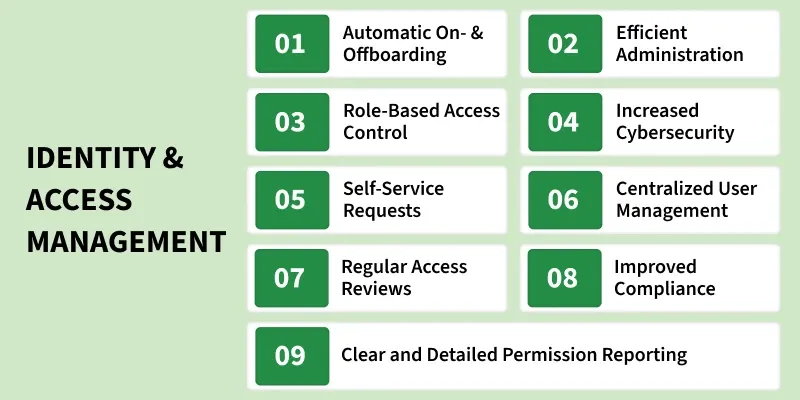
IAM provides multiple organizational benefits by improving security, efficiency and compliance.
1. Reduced Risk: IAM minimizes internal and external data breaches by enforcing controlled access and reducing dependency on weak or stolen credentials.
2. Secure and Scalable Access: As organizations grow, IAM enables secure access for increasing numbers of users without weakening security controls.
3. Compliance Management: IAM helps organizations meet regulatory requirements such as data protection laws, audit policies and industry standards.
4. Reduced Help Desk Load: Self-service features like password resets and authentication verification reduce help desk dependency and operational overhead.
5. Competitive Advantage: IAM allows controlled external access to partners and clients, improving collaboration without compromising security.
Implementation Guide for IAM
1. Analyze Organizational Needs: IAM solutions should be selected based on the organization’s size, industry, workforce structure and device usage.
2. Develop an IAM Integration Strategy: A structured strategy is required to manage identities across cloud services, on-premises systems and third-party tools.
3. Select the Right IAM Tools: Key IAM components include:
Access management systems
Multi-factor authentication (MFA)
Risk-based authentication
Password tokens and identity verification tools
Rise in Importance of IAM
IAM has become a foundational element of cybersecurity as organizations increasingly rely on digital infrastructure. Key Areas of Focus:
Identity Data Management: Secure handling of identity data across systems and platforms.
Access Management: Use of MFA, federation and stronger authentication mechanisms.
Access Governance: Regular auditing and enforcement of access policies.
Identity Lifecycle Management: Controlled creation, modification and removal of identities.
Data Security and Analytics: Monitoring and analyzing access patterns to detect threats.
IAM and Existing Cybersecurity Protocols
IAM strengthens cybersecurity by enforcing precise access controls.
Restricted Data Access: Users only access data relevant to their roles.
View-Only Access: Prevents unauthorized modification or copying of sensitive data.
Platform Restrictions: Limits users to approved platforms and environments.
Data Transfer Prevention: Prevents unauthorized sharing or exfiltration of data.
IAM complements existing security systems by adding identity-centric protection layers.
IAM Policies
A successful IAM framework relies on well-defined policies:
Identity recognition and authentication methods
Role and responsibility assignment
User lifecycle management (add, update, remove)
Controlled access for individuals and groups
Protection of sensitive data and systems from breaches
Advantages
Enhances overall security by limiting unauthorized access
Improves compliance with legal and regulatory frameworks
Simplifies identity and access administration
Enables Single Sign-On (SSO) for better user experience
Provides visibility into user behavior and access patterns
Limitations
Implementation complexity, especially in large organizations