|
VOOZH | about |
|
VOOZH | about |
The Diffie-Hellman algorithm is being used to establish a shared secret that can be used for secret communications while exchanging data over a public network using the elliptic curve to generate points and get the secret key using the parameters.
Step-by-Step explanation is as follows:
| Alice | Bob |
|---|---|
| Public Keys available = P, G | Public Keys available = P, G |
| Private Key Selected = a | Private Key Selected = b |
Key generated = | Key generated = |
| Exchange of generated keys takes place | |
| Key received = y | key received = x |
Generated Secret Key = | Generated Secret Key = |
Algebraically, it can be shown that | |
| Users now have a symmetric secret key to encrypt | |
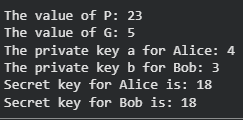
Example:
Step 1: Alice and Bob get public numbers P = 23, G = 5
Step 2: Alice selected a private key a = 4 and
 Bob selected a private key b = 3
Step 3: Alice and Bob compute public values
Alice: x =(5^4 mod 23) = (625 mod 23) = 4
 Bob: y = (5^3 mod 23) = (125 mod 23) = 10
Step 4: Alice and Bob exchange public numbers
Step 5: Alice receives public key y =10 and
 Bob receives public key x = 4
Step 6: Alice and Bob compute symmetric keys
 Alice: ka = y^a mod p = 10000 mod 23 = 18
 Bob: kb = x^b mod p = 64 mod 23 = 18
Step 7: 18 is the shared secret.
You can find more detail on what primitive roots of a number are in this article : Primitive root of a prime number n modulo n.
For our example the number 23(prime) has the following primitive roots : [5, 7, 10, 11, 14, 15, 17, 19, 20, 21].
Output: