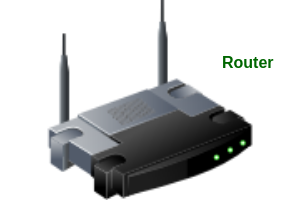
A router is a networking device that forwards data packets between different computer networks. It connects multiple packet-switched networks or subnetworks, managing traffic by directing packets to their intended IP addresses. Routers allow multiple devices to share an Internet connection efficiently.
Example: When you access www.google.com, your request is broken into packets. These packets don’t travel directly to Google’s server-they pass through a series of routers that examine and forward them along the most efficient path until they reach the destination.
How Does a Router Work?
Routers determine the path for a packet by examining its destination IP address and consulting the routing table, which contains information on network paths. They use a set of rules to identify the most efficient route for each packet.
Static routing: Configured manually, suitable for small or stable networks.
Dynamic routing: Automatically updated based on network activity, ideal for large or changing networks.
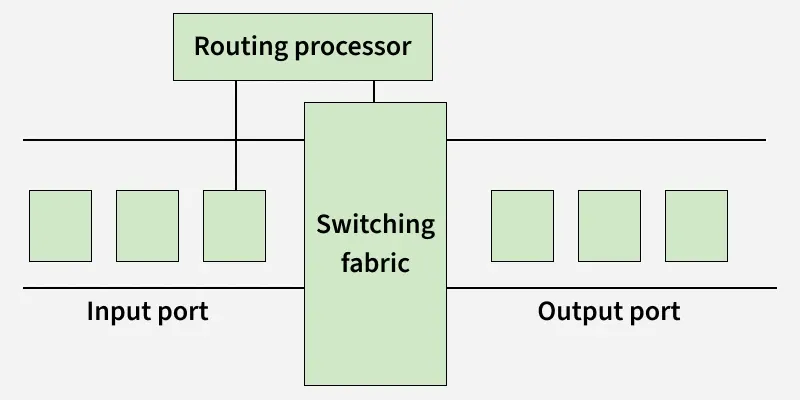
Input Port: Accepts packets, decapsulates them, and determines forwarding paths.
Switching Fabric: The core of the router connecting input ports to output ports. Can be implemented via:
Memory switching: CPU copies packets to output ports. Bus switching: Single bus transfers packets to the correct port. Interconnection networks: Complex designs connecting multiple input/output ports.
Output Port: Transmits packets to outgoing links, managing queuing and link-layer functions.
Routing Processor: Executes routing protocols and algorithms, maintaining the forwarding table.
Common Routing Protocols
Open Shortest Path First (OSPF): Determines the optimal path across networks.
Border Gateway Protocol (BGP): Shares routing information between edge routers.
Interior Gateway Routing Protocol (IGRP): Exchanges routing info within autonomous networks.
Enhanced IGRP (EIGRP): Requests routing paths from neighbors if unknown.
Exterior Gateway Protocol (EGP): Shares routing data between internet hosts.
Applications of Routers
Connect remote servers, networks, and devices globally.
Support wired and wireless communication, including high-speed data transfer.
Used by ISPs to transmit audio, video, image, and email efficiently.