Multiple Access Protocols are a set of rules used in computer networks to control how multiple devices share and access a common communication channel. Since simultaneous transmissions by multiple devices can lead to data collisions and loss, these protocols ensure orderly, fair, and efficient use of the shared medium by coordinating when and how each device is allowed to transmit data.
Note: These protocols manage network traffic by controlling which device can transmit, when it can transmit how collisions are handled. Without them, simultaneous transmissions would lead to interference, packet loss degraded performance.
Role in the OSI Model
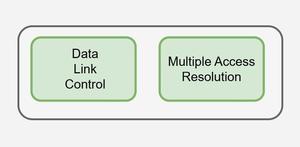
The Data Link Layer is responsible for the transmission of data between nodes. It has two major functions:
Data Link Control (DLC): Ensures reliable transmission using framing, error control flow control (e.g., Stop-and-Wait ARQ).
Multiple Access Control (MAC): Manages access when multiple stations share a common channel (non-dedicated link).
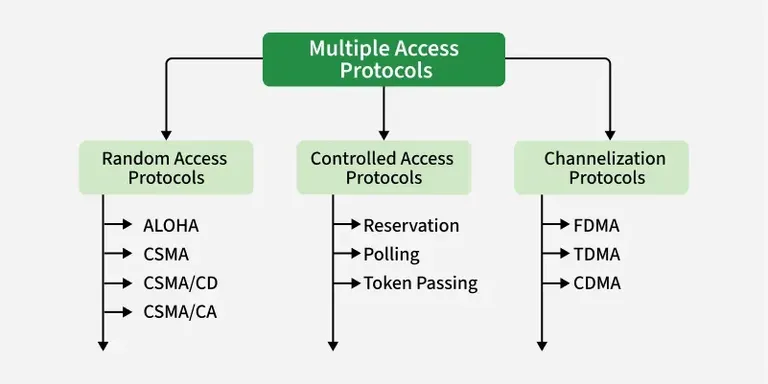
Multiple Access Protocols are categorized into three major types:
Random Access Protocols
Controlled Access Protocols
Channelization Protocols
Random Access Protocols
In this approach, all stations have equal priority. Transmission decisions are based on the state of the channel (idle or busy). Below are its Features:
No fixed order of transmission.
No fixed time slot assignment.
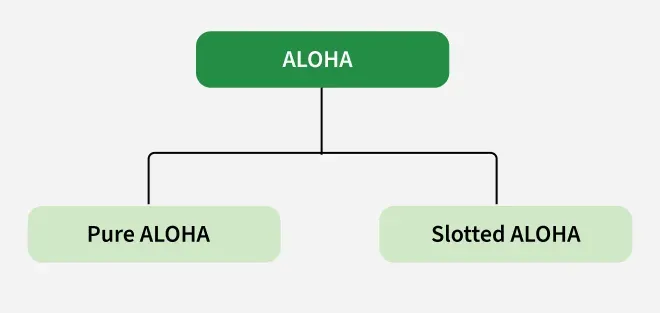
1. ALOHA
Designed for wireless LANs and shared media.
Multiple stations can transmit simultaneously, leading to collisions.