|
VOOZH | about |
|
VOOZH | about |
A Protocol Hierarchy is a fixed set of rules and conventions that govern the communication between two or more computers. The hierarchical structure allows for modular design, interoperability, and ease of implementation in computer networks.
A protocol is simply defined as a set of rules and regulations for data communication. Rules are defined for every step and process at the time of communication among two or more computers. Networks are needed to follow these protocols to transmit the data successfully. All protocols might be implemented using hardware, software, or a combination of both of them. There are three aspects of protocols given below :
Generally, Computer networks are comprised of or contain a large number of hardware and software. For network design, various networks are organized and arranged as a stack of layers of hardware and software, one on top of another. The number, name, content, and function of each layer might vary and can be different from one network to another. The main purpose of each layer is to provide services to higher layers that are present. Every layer has some particular task or function. The networks are organized and arranged as different layers or levels simply to reduce and minimize the complexity of the design of network software.
Example of Protocol Hierarchy
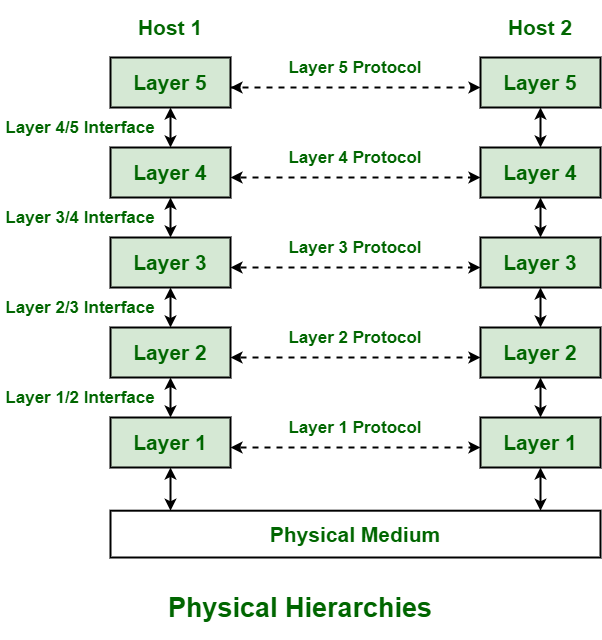
Below is diagram representing a five-layer network. The diagram shows communication between Host 1 and Host 2. The data stream is passed through a number of layers from one host to other. Virtual communication is represented using dotted lines between peer layers. Physical communication is represented using solid arrows between adjacent layers. Through physical medium, actual communication occurs. The layers at same level are commonly known as peers. The peer basically has a set of communication protocols. An interface is present between each of layers that are used to explain services provided by lower layer to higher layer.
👁 Example of Protocol Hierarchy
.png)