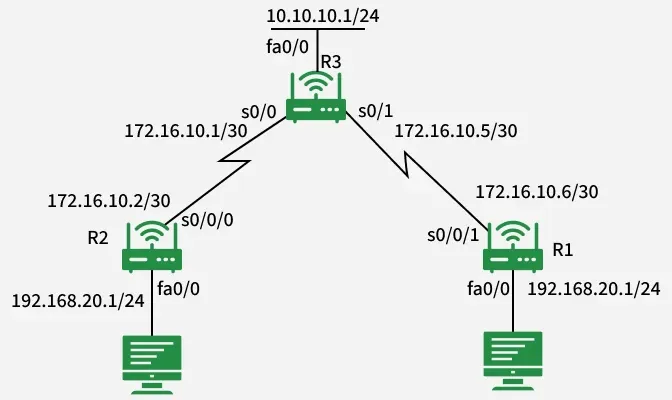
The Routing Information Protocol (RIP) is designed to help routers determine the best path for sending data packets across a network. It uses hop count as its routing metric and is primarily used in small to medium-sized networks due to its scalability limitations.
RIP operates at the Network Layer (Layer 3) of the OSI model and maintains routing tables on each router.
Every 30 seconds, routers exchange their complete routing tables with neighbours using periodic updates.
The hop count metric defines the number of routers a packet must pass through to reach its destination.
Note: RIP supports a maximum hop count of 15, which limits its use in larger networks. A hop count of 16 is considered unreachable.
Hop Count
Hop count is a routing metric that represents the total number of routers a data packet must pass through to travel from the source device to the destination device.
Each router crossed by a packet is counted as one hop.
Used by routing protocols like RIP to determine the best path.
RIP selects the route with the lowest hop count as the optimal route.
The maximum hop count in RIP is 15; a hop count of 16 is considered unreachable.
Limiting the hop count helps prevent routing loops.
This limitation reduces RIP’s scalability, making it unsuitable for large networks.