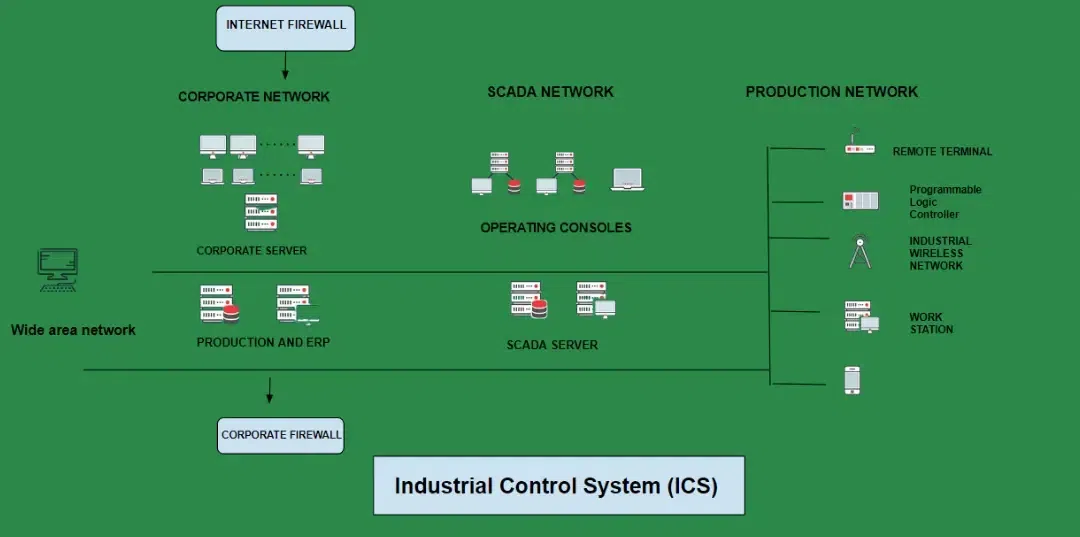
Industrial control systems (ICS) are a broad word used in manufacturing to refer to integrating network connections, hardware, and software to support vital infrastructure. In the context of critical infrastructure, ICS assets facilitate the efficient administration and operation of crucial services.
Devices for monitoring energy production, distribution, and transmission are among these assets in the power grid. An industrial control system manages production, distribution, handling of products, and manufacturing in the industrial sector.
What is an Industrial Control System (ICS)?
An industrial control system is an electronic control system and industrial process control is mostly used in instrumentation. Small modular panel-mounted controllers and massive interactive distributed control systems with hundreds of field connections are examples of different-sized control systems. This is designed to efficiently handle duties electronically and operates differently based on the industry. The manufacturing, transportation, energy, and water treatment sectors are just a few of the key infrastructure and industrial sectors that employ the devices and protocols found in an ICS today.
This is a solution for managing production systems located in one place. A DCS uses a controller that receives a setpoint and may tell valves or even an actuator how to function to maintain the intended setpoint. Field data can be utilized in complex control schemes including data from other regions of the plant, retained for later use, or used for simple process control. The primary function of SCADA systems is to monitor and control field sites remotely from a centralized control system.
Supervisory Control and Data Acquisition (SCADA)
A SCADA system cannot offer total control. Rather, its functionalities center around granting authority at the supervisory level. Generally speaking, SCADA systems consist of dispersed devices (commercial hardware modules or Programmable Logic Controllers, or PLCs) at different places.
Actual ICS Implementation
Integrating capabilities from both DCS and SCADA into an ICS environment typically results in a hybrid system. This makes it feasible to integrate features and functions from the two systems to fulfill specific operational requirements.
Components of an Industrial Control System (ICS) Environment
Information Technology (IT) and Operational Technology (OT)
IT is the software and the hardware utilized in processing information while OT is the systems that measures and controls the physical processes. OT and IT both are utilized in ICS setting but duties of OT differ sector wise.
Human-Machine Interface (HMI)
HMI is the interface through which an operator can interact with the ICS as well as the ability to visualize and manage many of the operations of a device.
Programmable Automation Controllers (PAC)
PACs provide far greater connectivity and control system options than conventional controllers, and so are indispensable in present day ICS settings.
Field Devices
These include various devices such as sensor which are vital for monitoring industrial processes as well as actuators, and instruments that are important for controlling industrial processes.
Data Historian
A data historian is an entity of a database that permanently records all the process information for its later usage in analytical or reallocation to corporate systems.
Remote Terminal Unit (RTU)
Remote Terminal Units are microprocessor controlled devices which oversee the status data acquisition and transmit the data to control centers.
Control Server
This applies to server hosting the supervisory control software for DCS or PLC systems and will manage lower level control devices.
Programmable Logic Controller (PLC)
DCS and SCADA both include PLC as an essential hardware part in which feedback control tools comprising of actuators or sensors are used for local control of processes.
Remote Diagnostics and Maintenance
This concerns the ability of identifying, avoiding and mitigating for abnormal operating conditions or component/subsystem/segment failures in the ICS context.
Communication within ICS Systems
Communication plays a significant role within an ICS setting for data to be exchanged freely in between components, controllers, and operators. Key methods include:
Wired and Wireless Networks: It is through these networks that data can be relayed to all the parts of an ICS, thus allowing real-time monitoring and control.
Industrial Protocols: In particular, Modbus, Profibus and OPC protocols are used for data exchange in the field devices and controllers as well as control servers.
Security Measures: It is crucial for maintaining the security of all the connections in ICS to ensure that cyber threats such as malicious attacks, encryptions, and authentications of the ICS have strong solutions in aspects of the encryption and segmentation of the networks.
Threats to Industrial Control Systems
To enhance the system operations and productivity, every ICS regularly adopts new and updated technologies and applications in both IT and OT.
The combination of IT and OT makes them more appealing to hackers and also can not protect SCADA and other legacy.
When ICS equipment is immediately accessible over the internet, hackers may exploit security flaws or inadequate authentication processes to get access and compromise it.
Phishing tactics might be used by attackers to fool staff members into disclosing their login credentials, giving them legal entry into the ICS environment.
Best Practices of Industrial Control Systems Security
Monitor Networks: Since linked devices on ICS networks tend to be static and change infrequently, it is imperative to monitor these networks. Setting up a baseline for typical network behavior through ongoing monitoring is essential to improving security.
Least Privilege: Many ICS protocols don't have enough access constraints, which might allow unauthorized users to access vital and sometimes dangerous functions. To use ICS protocol-aware firewalls to mitigate this risk, it's most critical.
Network Segmentation: Air gaps were formerly a sufficient means of providing security for ICS networks, but they are no longer so. To guarantee the security of equipment not meant for internet access, network segmentation is becoming more and more important.
Secure Remote Access: To monitor and operate globally dispersed ICS assets, remote access is often necessary. But it's crucial to make sure that strong encryption, access control, and authentication procedures are in place when establishing this access.
Advantages of Industrial Control Systems (ICS)
Improved Efficiency: Control processes are something that often need to be automated in order for the whole business to run more efficiently, and this is one of the ways in which ICS can prove beneficial in this regard.
Enhanced Monitoring: Useful for decision makers in order to have the necessary information in real time for system’s management.
Increased Safety: Oversees and manages potentially dangerous operations and dispenses with threats of mishap and conformity of appropriate safety measures.
Scalability: Equipment are available in models that can be expanded or reduced in sizes depending on the actual demands on operations.
Disadvantages of Industrial Control Systems (ICS)
High Initial Cost: It is often costly to implement and maintain ICS because of some of the requirements which may include the acquisition of new hardware, software, and integration.
Complexity: The control of an ICS as well as its maintenance is an intricate process that demands certain skills and expertise; thus, it may be considered difficult and expensive.
Security Risks: Organizational operations expose them to cyber threats and risks which affect system integrity and data security.
Integration Challenges: The primary limitation of using new technologies or system is that the integration process may be complicated when it comes to ICS especially when changes are being made.
Conclusion
In this article, we have learned about industrial control systems (ICS). Industrial control system refers to a group of terms used to characterize various kinds of control systems, to run and/or automate industrial processes this comprises the machinery, networks, systems, and controls needed.