|
VOOZH | about |
|
VOOZH | about |
Network segmentation divides a computer network into smaller, isolated segments to control and restrict communication. It enhances security by limiting unauthorized access and containing potential threats within defined boundaries.
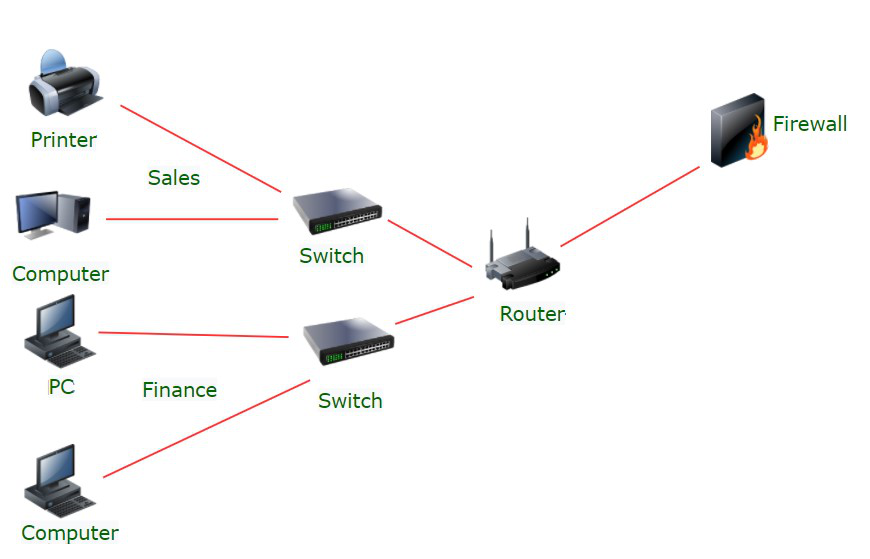
Example: In an organization with separate networks for Sales and Finance, users from one network cannot directly access resources on the other. If access is required, traffic must traverse a switch, router, and firewall enforcing security policies.
Network segmentation is used to:
There are several basic steps involved in how network segmentation works.
1. Identify and Group Assets: Classify devices, systems, and applications based on their function, sensitivity, or access requirements (e.g., HR, Finance, Guest).
2. Create Segments: Divide the network into logical or physical segments using subnets or VLANs, assigning distinct IP ranges.
3. Deploy Firewalls and Layer 3 Devices: Use routers and firewalls between segments to enforce security boundaries and control traffic based on policies.
4. Configure VLANs and ACLs: Use VLANs to logically group devices on the same physical network. Set Access Control Lists (ACLs) to permit or block traffic between segments.
5. Monitor Inter-Segment Traffic: Utilize Intrusion Detection/Prevention Systems (IDS/IPS) to detect malicious activity between segments.
6. Apply Least Privilege: Deny all non-essential inter-segment traffic by default. Permit only what's necessary for business operations.
7. Review and Update Policies: Regularly reassess firewall rules, ACLs, and segmentation strategies to reflect organizational and threat landscape changes.
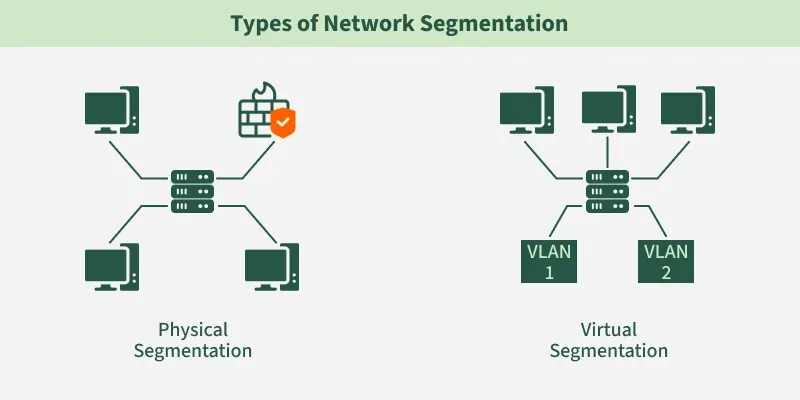
Network segmentation involves dividing a computer network into smaller parts to improve performance, security, and management. Here are the main types of network segmentation:
Segmentation is enforced using:
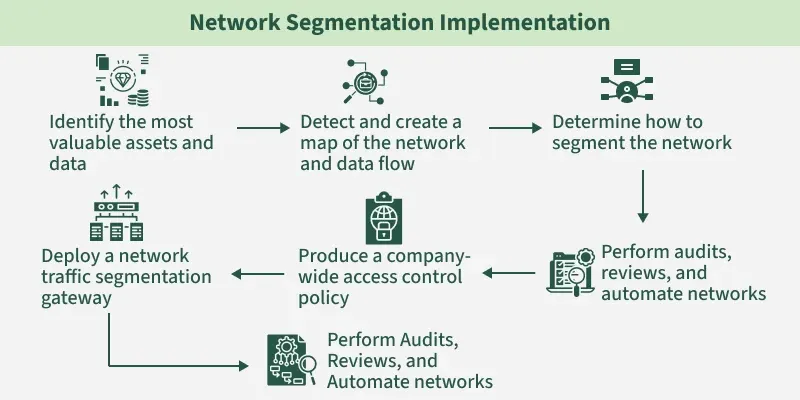
Implementing network segmentation involves strategic planning and the use of technologies like VLANs, subnets, firewalls, and access control policies.
1.Identify the most valuable assets and data: Determine which systems, applications, and information need the highest protection.
2. Detect and create a map of the network and data flow: Visualize how devices communicate and where data travels across the network.
3. Determine how to segment the network: Decide the segmentation strategy (e.g., VLANs, subnets, firewalls, zones).
4. Perform audits, reviews, and automate networks: Assess current configurations, identify gaps, and use automation for consistency.
5. Produce a company-wide access control policy: Define who can access what, ensuring least-privilege enforcement.
6. Deploy a network traffic segmentation gateway: Implement firewalls, ACLs, and gateways to enforce segmentation rules.
7. Perform ongoing audits, reviews, and automation: Continuously monitor, update, and optimize segmentation as the network evolves.
| Network Segmentation | Micro Segmentation |
|---|---|
| Divides a network into smaller subnetworks | Further divides segments into granular security zones |
| Controls north-south traffic | Controls east-west traffic |
| Implemented using VLANs, ACLs, and firewalls | Implemented using SDN and virtualization |
| Provides isolation between major segments | Provides fine-grained isolation within segments |