|
VOOZH | about |
|
VOOZH | about |
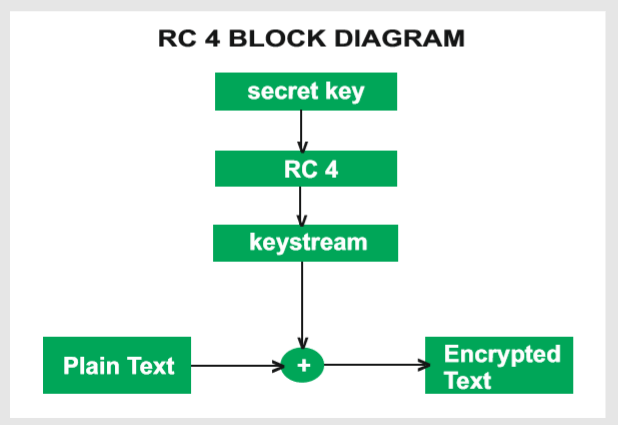
RC4 means Rivest Cipher 4 invented by Ron Rivest in 1987 for RSA Security. It is a Stream Ciphers. Stream Ciphers operate on a stream of data byte by byte. RC4 stream cipher is one of the most widely used stream ciphers because of its simplicity and speed of operation. It is a variable key-size stream cipher with byte-oriented operations. It uses either 64 bit or 128-bit key sizes. It is generally used in applications such as Secure Socket Layer (SSL), Transport Layer Security (TLS), and also used in IEEE 802.11 wireless LAN std.
Unauthorized data access can be prevented by encryption. If we perform encryption then third parties can not have access to data which we share or receive. The encryption is done by using a secret key, or we can say that by using a public key and private key. Both sender and receiver are having their public key and private key through which encryption of plain text and decryption of ciphertext is performed.
RC4 was designed by Ron Rivest in 1987. He was working under RSA Security. Rivest Cipher 4 is an official name while it is also known as Ron's Code. Initially, RC4 was trade secret but once it's code spread in the public domain it was no more a trade secret. While Ron did not reveal the RC4 algorithm until 2014 when he described the history of RC4 in English Wikipedia.
RC4 is used in various applications such as WEP from 1997 and WPA from 2003. We also find applications of RC4 in SSL from 1995 and it is a successor of TLS from 1999. RC4 is used in varied applications because of its simplicity, speed, and simplified implementation in both software and hardware.
There are various types of RC4 such as Spritz, RC4A, VMPC, and RC4A.
The algorithm operates on a user-selected variable-length key(K) of 1 to 256 bytes (8 to 2048 bits), typically between 5 and 16 bytes. To generate a 256-byte state vector S, the master key is used.
The first step is the array initialization. It is a character array of size 256 i.e. S[256]. After that, for every element of the array, we initialize S[i] to i.
Code for array initialization:
Char S[256];
int i;
for(i=0;i<256;i++)
S[i] = i
The array will look like -
S[] = {0, 1, 2, 3, ------, 254, 255}
After this, we will run the KSA algorithm-
KSA is going to use the secret key to scramble this array. KSA is a simple loop, in which we are having two variable i and j. We are using these variables to rearrange the array. Rearranging the array is done by using a secret key.
Code for KSA (Key Scheduling Algorithm ) :
int i, j=0;
for(i=0;i<256;i++)
{
j=( j + S[i] + T[i]) mod 256;
Swap(S[i], S[j]);
}
KSA has been scrambled, S[256] array is used to generate the PRGA(Pseudo Random Generation Algorithm). This is the actual Keystream.
Code for PRGA ( Pseudo Random Generation Algorithm ):
i=j=0;
while(true)
{
i = ( i + 1 ) mod 256;
j = ( j + S[i] ) mod 256;
Swap( S[i], S[j] );
t = ( S[i] + S[j] ) mod 256 ;
k = S[t];
}
This is the next step of scrambling.
Decryption is achieved by doing the same byte-wise X-OR operation on the Ciphertext.
Example: Let A be the plain text and B be the keystream (A xor B) xor B = A