|
VOOZH | about |
|
VOOZH | about |
In a world where wireless internet is everywhere, keeping our data safe when we send it is crucial. New technology and threats are always appearing, so Wi-Fi security protocols have to change too to keep up. WPA3 (Wi-Fi Protected Access 3) and WPA2 (Wi-Fi Protected Access 2) are two of the newest and most important ones. Let's have a closer look at what sets these two protocols apart and how they affect how safe wireless networks are.
WPA2 has been a pivotal aspect of Wi-Fi security for many years, offering strong encryption and authentication methods to protect wireless networks. It relies on the Advanced Encryption Standard (AES) for secure data transmission and utilizes a specific handshake process to establish trusted connections between devices and access points. Despite its effectiveness, WPA2 has experienced vulnerabilities such as the KRACK exploit, highlighting the necessity for a more resilient security protocol.
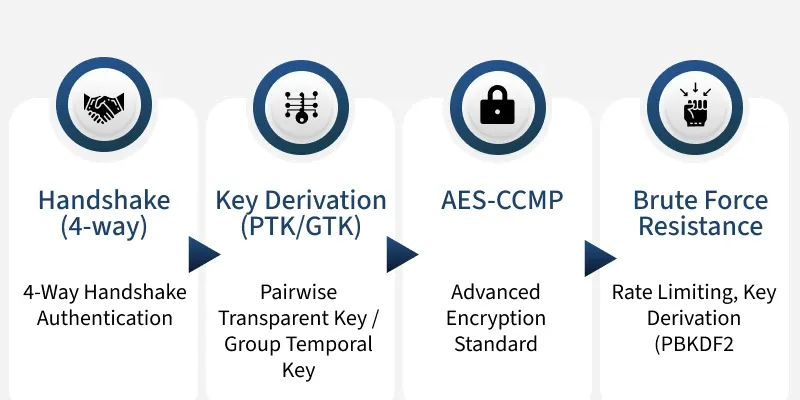
WPA2 is a widely adopted Wi-Fi security protocol that pairs AES encryption:
👁 secure_by_designWPA2 utilizes the Advanced Encryption Standard (AES), a highly secure encryption algorithm, to ensure robust protection for data transmitted across wireless networks.
WPA2 uses the 4-way handshake method for authentication, establishing trusted connections between devices and access points.
WPA2 is widely supported across various devices and networks, with existing hardware and software often compatible without requiring extensive updates.
WPA2 (Wi-Fi Protected Access 2), a well-known protocol extensively used in networks globally, has consistently provided reliable security for wireless connections.
WPA2 incorporates mechanisms to resist brute force attacks by limiting the number of login attempts and employing techniques such as key derivation functions to make password cracking more difficult.
WPA2 has strong ways to manage keys. It has the pairwise transient key (PTK) and group temporal key (GTK) to make keys for encoding and checking safely. This makes the network more secure.
WPA3 boosts Wi-Fi security with personalized data encryption and advanced authentication through techniques like Simultaneous Authentication of Equals (SAE). Additionally, it introduces Wi-Fi Easy Connect to securely link devices with restricted displays, thereby bolstering network security further.
WPA3 uses special encryption for information that keeps it safe and private. Each tool and connection gets its own unique key to lock up data. This stops hackers from getting your personal information.
WPA3 utilizes SAE, a stronger authentication method compared to the 4-way handshake used in WPA2, adding an extra layer of security against unauthorized access.
WPA3 gives better security from current dangers and weaknesses, especially those that were very well exploited in WPA2, like the KRACK attack.
In the new WPA3, there is Wi-Fi Easy Connect. This makes it easy for people to link devices with small screens. People can set up safe links with Wi-Fi Easy Connect without making security weak.
WPA3 implements forward secrecy, ensuring that even if a hacker captures and later cracks the encryption key, they cannot decrypt past network traffic. Each session key is unique, preventing retroactive decryption of captured data.
WPA3 strengthens protection against dictionary attacks by introducing a new mechanism that detects and blocks repeated failed authentication attempts, making it significantly harder for attackers to guess passwords or passphrases through automated methods.
Features | WPA3 | WPA2 |
|---|---|---|
Encryption | Implements individualized data encryption for heightened security. | Relies on the robust Advanced Encryption Standard (AES) for encryption. |
Authentication | Utilizes Simultaneous Authentication of Equals (SAE) for stronger authentication. | Uses the 4-way handshake method to authenticate devices and access points. |
Security | Offers enhanced resistance to modern attacks and vulnerabilities. | Vulnerable to exploits like KRACK, requiring additional precautions. |
Provisioning | Method Introduces Wi-Fi Easy Connect for secure device provisioning. | Relies on traditional methods, often involving a pre-shared key. |
Compatibility | Requires updates in hardware and software for full implementation. | Widely supported across devices, potentially needing firmware updates for full support. |
Implementation | Still in the adoption phase, with gradual integration into devices and networks. | Established protocol, already widely deployed across networks worldwide. |
The WPA3 is a big upgrade for Wi-Fi safety. It makes Wi-Fi safer, protecting against new dangers. Moving to WPA3 may cause troubles like devices not working together. But the stronger security makes the switch worth doing for groups and people looking to secure wireless networks in our ever-more connected world.