|
VOOZH | about |
|
VOOZH | about |
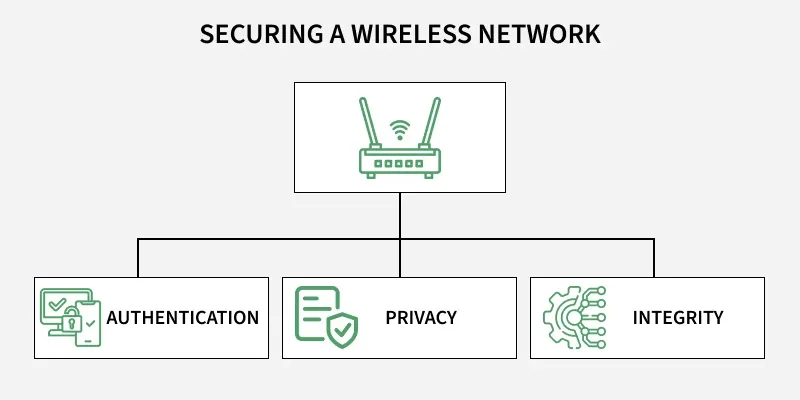
Wireless Network provides various comforts to end users, but actually, they are very complex in their operation. Many protocols and technologies are working behind the scenes to provide a stable connection to users. Data packets traveling through a wire provide a sense of security to users, as data traveling through a wire is probably not heard by eavesdroppers. To secure the wireless connection, we should focus on the following areas
Wireless clients connect to Access Points (APs) and exchange data over the air. As long as devices comply with the 802.11 standards, they can coexist on the network. However, not all devices are trustworthy; some rogue devices may pose serious threats to wireless security. Such devices can steal sensitive data or disrupt network availability. To safeguard against these risks, wireless security is enforced through various methods, including authentication, encryption, and access control.
There are broadly two types of Authentication processes: Wired Equivalent Privacy (WEP) and Extensible Authentication Protocol (802.1x/EAP). These are explained as follows.
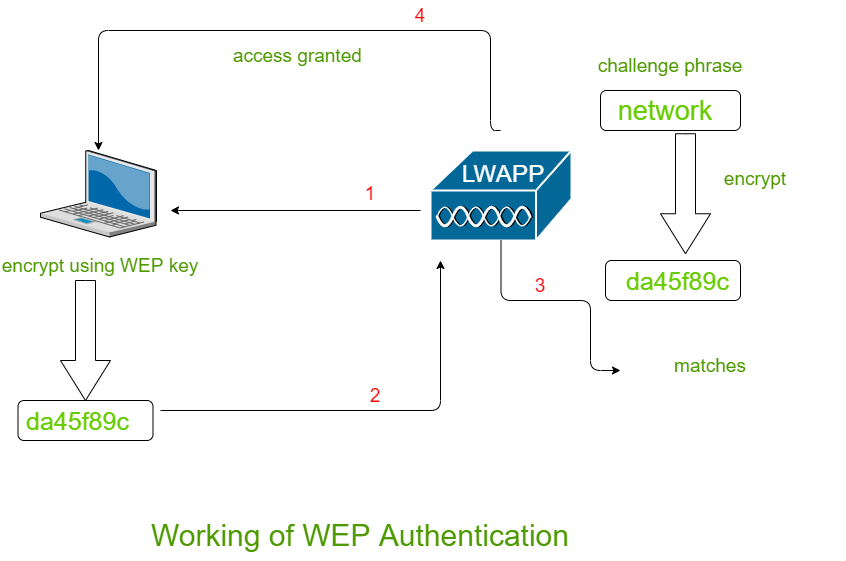
In wireless communication, open authentication offers no security. WEP uses the RC4 cipher to encrypt and decrypt data with a shared WEP key, which can serve as both authentication and encryption. A client can connect to an AP only if it has the correct key. The AP verifies this by sending a challenge phrase; if the client encrypts it correctly, access is granted.
👁 ImageEAP is a flexible authentication framework used in wireless networks and Point-to-Point connections. It allows different authentication methods (passwords, digital certificates, smart cards, tokens, biometrics, etc.) instead of being limited to one fixed method. 802.1X is a port-based access control standard that uses EAP for authentication. It involves three key components:
EAP is further of four types with some amendments over each other -
Wi-Fi has become the backbone of modern communication, powering everything from personal smartphones to enterprise systems. But because it uses wireless radio waves, it’s much easier for attackers to intercept or manipulate data compared to wired connections. Here’s why securing it is essential:
Most breaches occurred due to weak encryption (like WEP), open Wi-Fi, poor authentication, or outdated protocols (WPA2). Here is a list of common real-world breaches caused by weak Wi-Fi security:
In 2007, TJX Companies suffered a massive breach because their Wi-Fi used weak WEP encryption. Hackers cracked the key, intercepted payment traffic, and stole over 45 million credit card details. This cost the company about $250 million. It is caused by using outdated Wi-Fi security like WEP makes it easy for hackers to steal sensitive data. Always use stronger encryption (like WPA3).
In the Marriott Hotels breach (2014–2018), attackers took advantage of poorly secured Wi-Fi and vendor systems. Through these weak points, they gained access to Marriott’s internal networks and stayed undetected for years. This led to the theft of 500 million guest records, including personal details, credit card numbers, and even passport data. It is done due to Weak Wi-Fi security can open the door for attackers to steal massive amounts of sensitive customer data.
Hackers exploited weak Wi-Fi and remote network settings at Manchester United. This attack disrupted the club’s critical IT and communication systems, forcing parts of the network offline. The club suffered major financial losses and reputational damage as a result, Weak Wi-Fi or remote access settings can let attackers shut down essential systems and cause huge business losses.
Public Wi-Fi networks are often open and unsecured, meaning they have no encryption. Hackers exploit this by launching Man-in-the-Middle (MITM) attacks to steal logins, inject malware, and capture private data. This results in identity theft and financial fraud, affecting thousands of users every day.
The KRACK attack exploited a flaw in the WPA2 handshake process, which allowed hackers to intercept and even alter Wi-Fi traffic that was thought to be secure. This vulnerability affected almost all Wi-Fi devices worldwide until security patches were released.
LAN is used over Wi-Fi because it is faster, more stable, more secure, and better for high-performance tasks. Wi-Fi is convenient for mobility, but LAN is preferred when performance and security matter.
Physical Access Required
Lower Risk of Eavesdropping
Resistance to Rogue Devices
Better Control & Monitoring