|
VOOZH | about |
|
VOOZH | about |
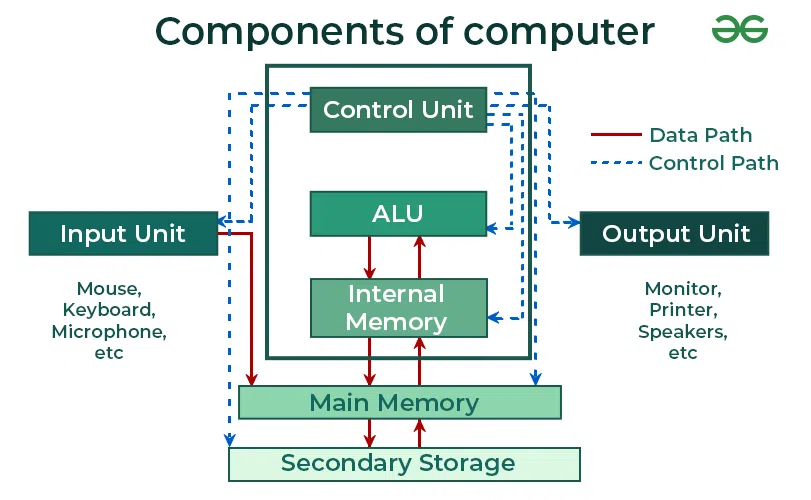
The functional components of a digital computer include the Input Unit, which takes in data; the CPU, which processes data with its Control Unit (CU), Arithmetic Logic Unit (ALU), and Registers; the Memory Unit, which stores data temporarily (RAM) or permanently (HDD/SSD); the Output Unit, which displays results; and the Bus System, which connects and transfers data between components. These parts work together to execute tasks and provide results.
The functional components of a computer are the key parts that work together to process and manage data. These include the Input Unit for receiving data, the CPU for processing it, the Memory Unit for storing information, the Output Unit for displaying results, and the Bus System that connects all parts. These components help the computer perform tasks efficiently.
The CPU executes instructions and controls all internal operations. In 2025, CPUs will often have multiple cores and threads to handle parallel processing efficiently.
The memory unit holds data and instructions before, during, and after processing.
A computer consists of an input unit that takes input, a CPU that processes the input and an output unit that produces output. All these devices communicate with each other through a common bus. A bus is a transmission path, made of a set of conducting wires over which data or information in the form of electric signals is passed from one component to another in a computer. The bus can be of three types – Address bus, Data bus and Control Bus.
The following figure shows the connection of various functional components:
The address bus carries the address location of the data or instruction. The data bus carries data from one component to another, and the control bus carries the control signals. The system bus is the common communication path that carries signals to/from the CPU, main memory and input/output devices. The input/output devices communicate with the system bus through the controller circuit, which helps in managing various input/output devices attached to the computer.
The functional components of a computer work in unison to process data and perform tasks efficiently. Each component, from the input and output units to the CPU, memory, and bus system, has a crucial role in handling information, carrying out calculations, and delivering results. Understanding how these components interact helps us appreciate how a computer operates and how its hardware and software collaborate to perform complex functions.