|
VOOZH | about |
|
VOOZH | about |
C++ is a widely used programming language known for its performance, flexibility, and object-oriented features. It remains highly relevant and is used by top tech companies for system-level and high-performance applications. This article presents the top 50+ C++ interview questions to help you prepare effectively.
C++ is a general-purpose, object-oriented programming language developed by Bjarne Stroustrup. It is an extension of C that supports both procedural and object-oriented programming, making it suitable for system-level as well as application-level development.
Advantages of C++:
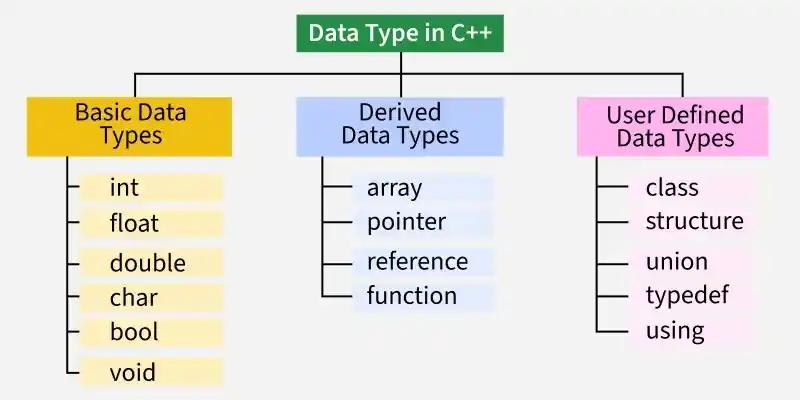
Data types define the kind of data a variable can store.
Following is the list of data types in C++:
'std' is also known as Standard or it can be interpreted as a namespace. The command "using namespace std" informs the compiler to add everything under the std namespace and inculcate them in the global namespace. This all inculcation of global namespace benefits us to use "cout" and "cin" without using "std::_operator_".
In C++, references are an alternative way to create an alias for another variable. A reference acts as a synonym for a variable, allowing you to access the variable directly without any additional syntax. They must be initialized when created and cannot be changed to refer to another variable afterward. This feature makes it easier to manipulate variables in functions while avoiding the overhead of copying large objects. A reference variable is preceded with a '&' symbol.
Syntax:
int GFG = 10;
// reference variable
int& ref = GFG;
In this programming language to call a function we have 2 methods: Call by Value and Call by Reference
Call by Value | Call by Reference |
|---|---|
| A copy of a variable is passed. | A variable itself is passed fundamentally. |
| Calling a function by sending the values by copying variables. | Calling a function by sending the address of the passed variable. |
| The changes made in the function are never reflected outside the function on the variable. In short, the original value is never altered in Call by Value. | The changes made in the functions can be seen outside the function on the passed function. In short, the original value is altered in Call by reference. |
| Passed actual and formal parameters are stored in different memory locations. Therefore, making Call by Value a little memory inefficient. | Passed actual and formal parameters are stored in the same memory location. Therefore, making Call by Reference a little more memory efficient. |
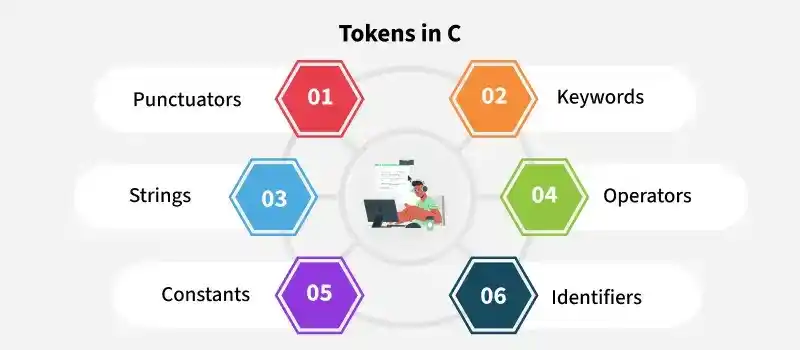
A token is the smallest individual element of a program that is understood by a compiler. A token comprises the following:
The following table lists the major differences between C and C++:
C | C++ |
|---|---|
| It is a procedural programming language. In simple words, it does not support classes and objects | It is a mixture of both procedural and object-oriented programming languages. In simple words, it supports classes and objects. |
| It does not support any OOPs concepts like polymorphism, data abstraction, encapsulation, classes, and objects. | It supports all concepts of data |
| It does not support Function and Operator Overloading | It supports Function and Operator Overloading respectively |
| It is a function-driven language | It is an object-driven language |
Following table lists the primary difference between struct and class:
| Aspect | struct | class |
|---|---|---|
| Default Access Modifier | Members are public by default. | Members are private by default. |
| Memory Allocation | Can be allocated on the stack or heap. | Can be allocated on the stack or heap. |
| Inheritance | Supports inheritance (with public, protected, or private access). | Supports inheritance (with public, protected, or private access). |
| Use Case | Often used for Plain Old Data (POD) structures, or simple data grouping. | Suitable for complex objects that may include methods, constructors, and destructors. |
Following are the main difference between reference and pointer:
Reference | Pointer |
|---|---|
| The value of a reference cannot be reassigned | The value of a pointer can be reassigned |
| It can never hold a null value as it needs an existing value to become an alias of | It can hold or point at a null value and be termed as a nullptr or null pointer |
| To access the members of class/struct it uses a ' . ' | To access the members of class/struct it uses a ' -> ' |
| The memory location of reference can be accessed easily or it can be used directly | The memory location of a pointer cannot be accessed easily as we have to use a dereference ' * ' |
Following is the main difference operator overloading and function overloading:
Function Overloading | Operator Overloading |
|---|---|
| It is basically defining a function in numerous ways such that there are many ways to call it or in simple terms you have multiple versions of the same function | It is basically giving practice of giving a special meaning to the existing meaning of an operator or in simple terms redefining the pre-redefined meaning |
| Parameterized Functions are a good example of Function Overloading as just by changing the argument or parameter of a function you make it useful for different purposes | Polymorphism is a good example of an operator overloading as an object of allocations class can be used and called by different classes for different purposes |
Example of Function Overloading:
| Example of Operator Overloading:
|
The major differences between the arrays and lists are:
Arrays | Lists |
|---|---|
| Array are contiguous memory locations of homogenous data types stored in a fixed location or size. | Lists are classic individual elements that are linked or connected to each other with the help of pointers and do not have a fixed size. |
| Arrays are static in nature. | Lists are dynamic in nature |
| Uses less memory than linked lists. | Uses more memory as it has to store the value and the pointer memory location |
const int x = 10; // Type safe
#define y 10 // No type checking
Following are the major difference between while and do-while loop:
| Feature | while loop | do-while loop |
|---|---|---|
| Condition Check | Checks condition before execution | Checks condition after execution |
| Execution Guarantee | May not execute even once | Executes at least once |
| Syntax Structure | while(condition) { ... } | do { ... } while(condition); |
| Use Case | When number of iterations is unknown | When loop must run at least once |
| Semicolon Requirement | No semicolon after condition | Ends with a semicolon (;) |
Storage class is used to defines the scope (visibility), lifetime, and linkage of variables or functions. These features usually help in tracing the existence of a variable during the runtime of a program.
Syntax:
storage_class var_data_type var_name;
Some types of storage classes:
Following are the major difference between prefix and postfix:
prefix | postfix |
|---|---|
| It simply means putting the operator before the operand | It simply means putting the operator after the operand |
| It executes itself before '; ' | It executes itself after '; ' |
| Associativity of prefix ++ is right to left | Associativity of postfix ++ is left to right |
Following are the major difference between new and malloc()
new | malloc() |
|---|---|
| new is an operator which performs an operation | malloc is a function that returns and accepts values |
| new calls the constructors | malloc cannot call a constructor |
| new is faster than malloc as it is an operator | malloc is slower than new as it is a function |
| new returns the exact data type | malloc returns void* |
Following are the major difference between virtual functions and pure virtual functions
Virtual Function | Pure Virtual Function |
|---|---|
| A Virtual Function is a member function of a base class that can be redefined in another derived class. | A Pure Virtual Function is a member function of a base class that is only declared in a base class and defined in a derived class to prevent it from becoming an abstract class. |
| A virtual Function has its definition in its respective base class. | There is no definition in Pure Virtual Function and is initialized with a pure specifier (= 0). |
| The base class has a virtual function that can be represented or instanced; In simple words, its object can be made. | A base class having pure virtual function becomes abstract that cannot be represented or instanced; In simple words, it means its object cannot be made. |
A class is a user-defined data type where all the member functions and data members are tailor-made according to demands and requirements in addition to which these all can be accessed with the help of an object. To declare a user-defined data type we use a keyword class.
An object is an instance of a class and an entity with value and state; In simple terms, it is used as a catalyst or to represent a class member. It may contain different parameters or none.
Note: A class is a blueprint that defines functions which are used by an object.
When a function of the same name, same arguments or parameters, and same return type already present/declared in the base class is used in a derived class is known as Function Overriding. It is an example of Runtime Polymorphism or Late Binding which means the overridden function will be executed at the run time of the execution.
Following are the OOPs concepts in C++:
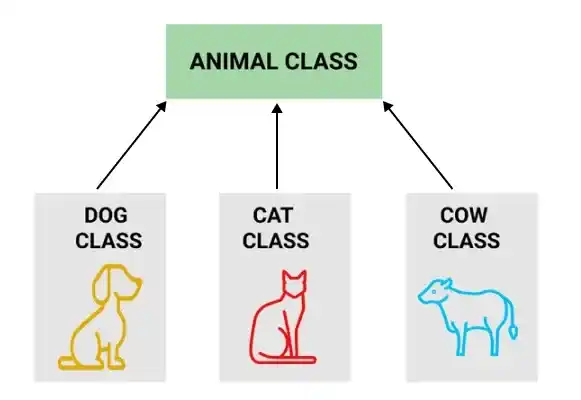
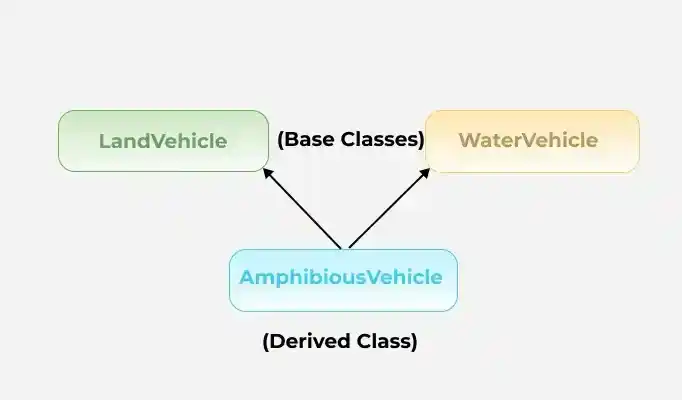
Inheritance is a mechanism in which a class (derived class) acquires the properties and behaviors of another class (base class). It promotes code reuse and helps represent relationships between classes.
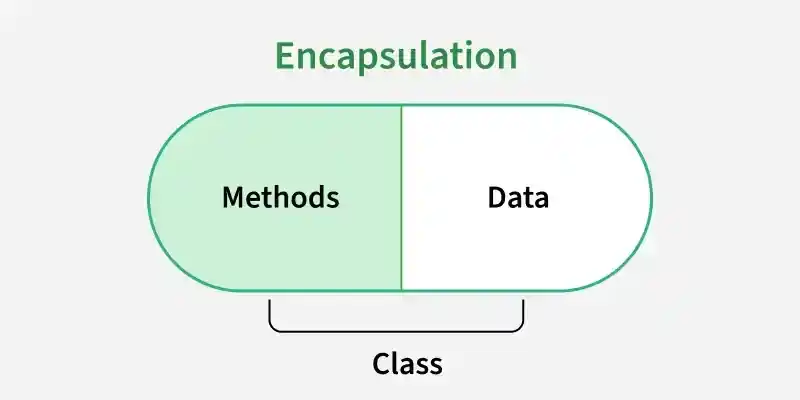
Encapsulation is the concept of wrapping data members and member functions together inside a class and restricting direct access to the data. It is usually implemented using access specifiers such as private, protected, and public. Sensitive data is kept private and accessed through public member functions.
Virtual inheritance is a technique that ensures only one copy of a base class's member variables is inherited by grandchild-derived classes. Or in simple terms, virtual inheritance is used when we are dealing with a situation of multiple inheritances but want to prevent multiple instances of the same class from appearing in the inheritance hierarchy.
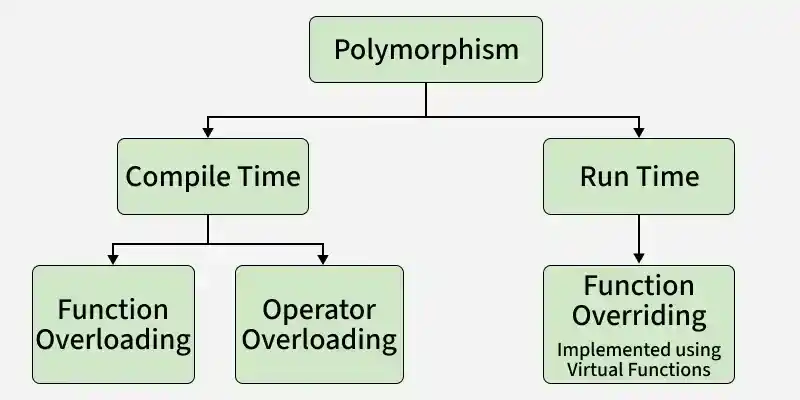
Polymorphism means one interface, multiple implementations.
It allows the same function or operator to behave differently depending on the context.
In C++, polymorphism can be achieved through:
There is 2 type of polymorphism
1. Compile Time Polymorphism or Static Binding: This type of polymorphism is achieved during the compile time of the program which results in it making a bit faster than Run time. Also, Inheritance is not involved in it. It is comprised of 2 further techniques:
Function Overloading: When there are multiple functions with the same name but different parameters then this is known as function overloading.
Operator Overloading: It is basically giving practice of giving a special meaning to the existing meaning of an operator or in simple terms redefining the pre-redefined meaning
Run-Time Polymorphism or Late Binding: Run-time polymorphism takes place when functions are invoked during run time.
Function Overriding: Function overriding occurs when a base class member function is redefined in a derived class with the same arguments and return type.
Output:
Function of derived classFollowing are the major differences between the runtime and compile time polymorphism:
Compile-Time Polymorphism | Runtime Polymorphism |
|---|---|
| It is also termed static binding and early binding. | It is also termed Dynamic binding and Late binding. |
| It is fast because execution is known early at compile time. | It is slow as compared to compile-time because execution is known at runtime. |
| It is achieved by function overloading and operator overloading. | It is achieved by virtual functions and function overriding. |
A constructor is a special type of member function of a class, whose name is the same as that of the class by whom it is invoked and initializes value to the object of a class.
There are 3 types of constructors:
1. Default constructor: It is the most basic type of constructor which accepts no arguments or parameters. Even if it is not called the compiler calls it automatically when an object is created.
Example:
2. Parameterized constructor: It is a type of constructor which accepts arguments or parameters. It has to be called explicitly by passing values in the arguments as these arguments help initialize an object when it is created. It also has the same name as that of the class.
Also, It is used to overload constructors.
Example:
Output
G.x = 10, G.y = 153. Copy Constructor: A copy constructor is a member function that initializes an object using another object of the same class. Also, the Copy constructor takes a reference to an object of the same class as an argument.
Example:
Destructors are members of functions in a class that delete an object when an object of the class goes out of scope. Destructors have the same name as the class preceded by a tilde (~) sign. Also, destructors follow a down-to-top approach, unlike constructors which follow a top-to-down.
Syntax:
~constructor_name(); // tilde sign signifies that it is a destructor
When destroying instances or objects of a derived class using a base class pointer object, a virtual destructor is invoked to free up memory space allocated by the derived class object or instance.
Virtual destructor guarantees that first the derived class' destructor is called. Then the base class's destructor is called to release the space occupied by both destructors in the inheritance class which saves us from the memory leak. It is advised to make your destructor virtual whenever your class is polymorphic.
The simple answer is NO we cannot overload a destructor. It is mandatory to only destructor per class in C++. Also to mention, Destructor neither take arguments nor they have a parameter that might help to overload.
Example:
Pointers are the variables that are used to store the address location of another variable. Operations that are permitted to a pointer are:
The delete operator is used to delete/remove all the characteristics/properties from an object by deallocating its memory; furthermore, it returns true or false in the end. In simple terms, it destroys or deallocates array and non-array(pointer) objects which are created by new expressions.
delete[] | delete |
|---|---|
| It is used for deleting a whole array | It is used to delete only one single pointer |
| It is used for deleting the objects of new[]; By this, we can say that delete[] is used to delete an array of objects | It is used for deleting the objects of new; By this, we can say that delete is used to delete a single object |
| It can call as many destructors it wants | It can only call the destructor of a class once |
A friend class is a class that can access both the protected and private variables of the classes where it is declared as a friend.
Example of friend class:
A friend function is a function used to access the private, protected, and public data members or member functions of other classes. It is declared with a friend keyword. The advantage of a friend function is that it is not bound to the scope of the class and once it is declared in a class, furthermore to that, it cannot be called by an object of the class; therefore it can be called by other functions. Considering all the mentioned points we can say that a friend function is a global function.
Example of friend function:
Overflow Error occurs when the number is too large for the data type to handle. In simple terms, it is a type of error that is valid for the defined but exceeds used the defined range where it should coincide/lie.
For example, the range of int data type is –2,147,483,648 to 2,147,483,647 and if we declare a variable of size 2,247,483,648 it will generate a overflow error.
A scope resolution operator is denoted by a '::' symbol. Just like its name this operator resolves the barrier of scope in a program. A scope resolution operator is used to reference a member function or a global variable out of their scope furthermore to which it can also access the concealed variable or function in a program.
Scope Resolution is used for numerous amounts of tasks:
The access restriction specified to the class members (whether it is member function or data member) is known as access modifiers/specifiers.
Access Modifiers are of 3 types:
Yes, it is absolutely possible to compile a program without a main(). For example Use Macros that defines the main
STL is known as Standard Template Library, it is a library that provides 4 components like container, algorithms, and iterators.
STL containers are predefined data structures in C++ that store collections of data in various ways. They are categorized into three types:
1. Sequence Containers: Maintain the order of insertion.
Example:
vector<int> v = {1, 2, 3};
2. Associative Containers: Store elements using keys (ordered).
Example:
map<string, int> age;
age["Alice"] = 25;
3. Unordered Associative Containers: Use hash tables instead of trees.
Example:
unordered_map<string, int> scores;
4. Container Adapters: Built on other containers with restricted interface
Containers save time and effort by providing built-in operations like insertion, deletion, and search with optimal complexity.
An iterator is an object (like a pointer) used to traverse containers. STL uses iterators to access elements in a uniform manner, regardless of the container. Iterators help in writing generic algorithms that work across different container types.
Types of Iterators:
| Type | Description |
|---|---|
| Input Iterator | Read-only access, single pass |
| Output Iterator | Write-only access, single pass |
| Forward Iterator | Read/write, multiple passes |
| Bidirectional | Traverse both directions |
| Random Access | Direct jump to any position (e.g., vector) |
Lambda expressions are anonymous functions defined inline using the [] syntax. They are commonly used with STL algorithms to simplify code.
[ capture ] (parameters) -> return_type { body }
Example:
Set and map do not allow duplicate keys. The insert() method returns a pair<iterator, bool>, where bool indicates success.
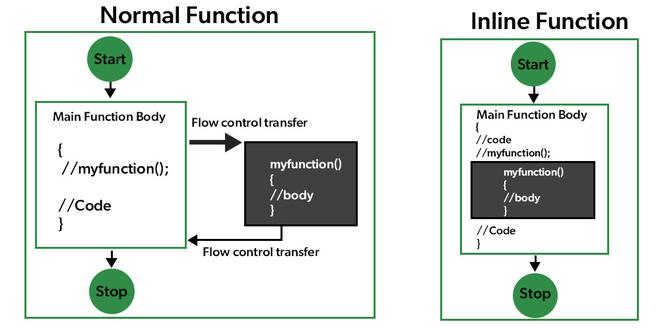
An inline function is a form of request not an order to a compiler which results in the inlining of our function to the main function body. An inline function can become overhead if the execution time of the function is less than the switching time from the caller function to called function. To make a function inline use the keyword inline before and define the function before any calls are made to the function.
Syntax:
inline data_type function_name()
{
Body;
}
The answer is No; It cannot be recursive.
An inline function cannot be recursive because in the case of an inline function the code is merely placed into the position from where it is called and does not maintain a piece of information on the stack which is necessary for recursion.
Plus, if you write an inline keyword in front of a recursive function, the compiler will automatically ignore it because the inline is only taken as a suggestion by the compiler.
When to use an abstract class?
A static data member belongs to the class, not to individual objects. Only one copy exists, shared by all objects.
Syntax:
static Data_Type Data_Member;
A static member function can access only static members of the class and can be called using the class name.
Syntax:
classname::function name(parameter);
Just like its name, things can change suddenly and unexpectantly; So it is used to inform the compiler that the value may change anytime. Also, the volatile keyword prevents the compiler from performing optimization on the code. It was intended to be used when interfacing with memory-mapped hardware, signal handlers, and machine code instruction.
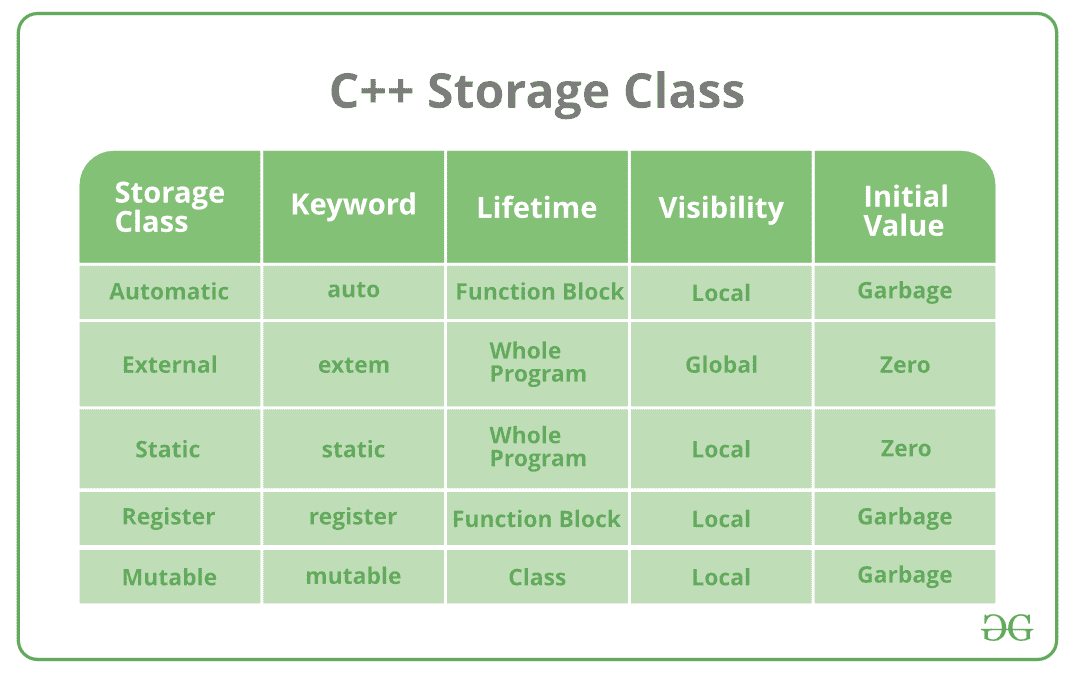
Storage class is used to define the features(lifetime and visibility) of a variable or function. These features usually help in tracing the existence of a variable during the runtime of a program.
Syntax:
storage_class var_data_type var_name;
Some types of storage classes:
Just like its name, the mutable storage class specifier is used only on a class data member to make it modifiable even though the member is part of an object declared as const. Static or const, or reference members cannot use the mutable specifier. When we declare a function as const, this pointer passed to the function becomes const.
So the scope of a variable is a region where a variable is accessible. There are two scope regions, A global and block or local.
A block scope variable is also known as a local scope variable. A variable that is defined inside a function (like main) or inside a block (like loops and if blocks) is a local variable. It can be used ONLY inside that particular function/block in which it is declared. a block-scoped variable will not be available outside the block even if the block is inside a function.
The auto keyword may be used to declare a variable with a complex type in a straightforward fashion. You can use auto to declare a variable if the initialization phrase contains templates, pointers to functions, references to members, etc. With type inference capabilities, we can spend less time having to write out things the compiler already knows. As all the types are deduced in the compiler phase only, the time for compilation increases slightly but it does not affect the runtime of the program.
Namespaces enable us to organize named items that would otherwise have global scope into smaller scopes, allowing us to give them namespace scope. This permits program parts to be organized into distinct logical scopes with names. The namespace provides a place to define or declare identifiers such as variables, methods, and classes.
Or we could say that A namespace is a declarative zone that gives the identifiers (names of types, functions, variables, and so on) within it a scope. Namespaces are used to arrange code into logical categories and to avoid name clashes, which might happen when you have many libraries in your code base.
The void keyword, when used as a function return type, indicates that the function does not return a value. When used as a parameter list for a function, void indicates that the function takes no parameters. Non-Value Returning functions are also known as void functions. They're called "void" since they're not designed to return anything. True, but only partially. We can't return values from void functions, but we can certainly return something. Although void functions have no return type, they can return values.
Following are the primary differences between the shallow copy VS deep copy:
Shallow Copy | Deep Copy |
|---|---|
| In Shallow copy, a copy of the original object is stored and only the reference address is finally copied. In simple terms, Shallow copy duplicates as little as possible | In Deep copy, the copy of the original object and the repetitive copies both are stored. In simple terms, Deep copy duplicates everything |
| A shallow copy of a collection is a copy of the collection structure, not the elements. With a shallow copy, two collections now share individual elements. | A deep copy of a collection is two collections with all of the elements in the original collection duplicated. |
| A shallow copy is faster | Deep copy is comparatively slower. |
Yes, we can call a virtual function from a constructor. But it can throw an exception of overriding.
Just like its name a void pointer is a pointer that is not associated with anything or with any data type. Nevertheless, a void pointer can hold the address value of any type and can be converted from one data type to another.