Object-Oriented Programming (OOP) is a programming paradigm that organizes software around objects, which combine data and functions. It is widely used to build modular, reusable, and scalable applications.
Organizes programs using classes and objects, making code structured and easier to manage.
Improves code reusability and maintainability using concepts like inheritance and modular design.
Models real-world problems using encapsulation, inheritance, polymorphism, and abstraction.
Real-Life Example of OOP
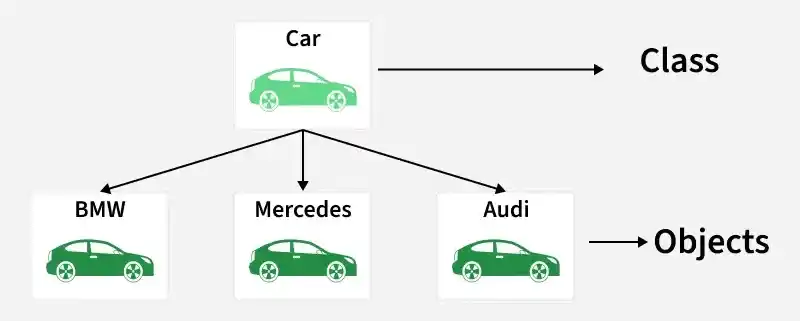
Car System Example
A car manufacturing system is one of the best examples of Object-Oriented Programming.
Different cars may have different colors, speeds, and models, but all are created using the same Car blueprint. Similarly, in OOP, multiple objects are created from a single class.
Advantages of OOP
Object-Oriented Programming (OOP) provides a structured approach to software development by organizing code into objects and classes. It improves reusability, scalability, and maintainability of programs.
Promotes code reusability through modular design and inheritance, reducing development time and effort.
Breaks complex problems into smaller objects, making programs easier to design, understand, and debug.
Improves software maintainability and scalability by supporting structured and organized code architecture.
Enhances security using data hiding and encapsulation to restrict direct access to sensitive data.
Maps real-world entities into objects, making problem-solving more natural and intuitive.
Disadvantages of OOP
Although Object-Oriented Programming (OOP) offers many advantages, it also has certain limitations that can affect development in some cases.
OOP programs are usually larger than procedural programs, which can sometimes lead to slower execution and reduced performance.
It is not suitable for all types of problems and may be unnecessary for small or simple applications.
Requires strong design and planning skills, making development more complex for beginners.
Has a learning curve, as understanding object-based thinking takes time for new programmers.
Treating everything as objects can sometimes make program design unnecessarily complicated.