|
VOOZH | about |
|
VOOZH | about |
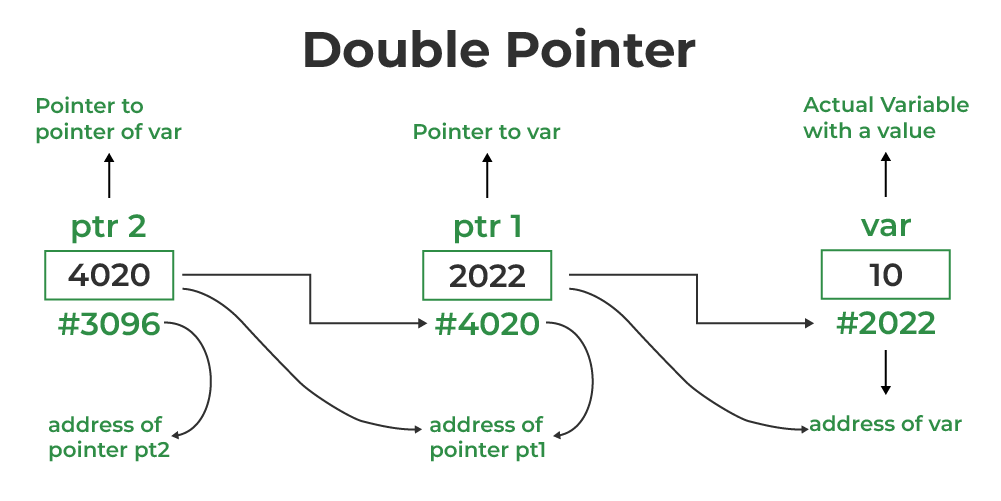
Now, we already know that a pointer stores the memory address of other variables. So, when we define a pointer to a pointer, the first pointer is used to store the address of the variables, and the second pointer stores the address of the first pointer. For this very reason, this is known as a Double Pointer or Pointer to Pointer.
The below diagram explains the concept of Double Pointers :
In a double pointer, Pointer 1 stores the address of a variable, and Pointer 2 stores the address of Pointer 1. This setup is called a pointer to pointer or double pointer.
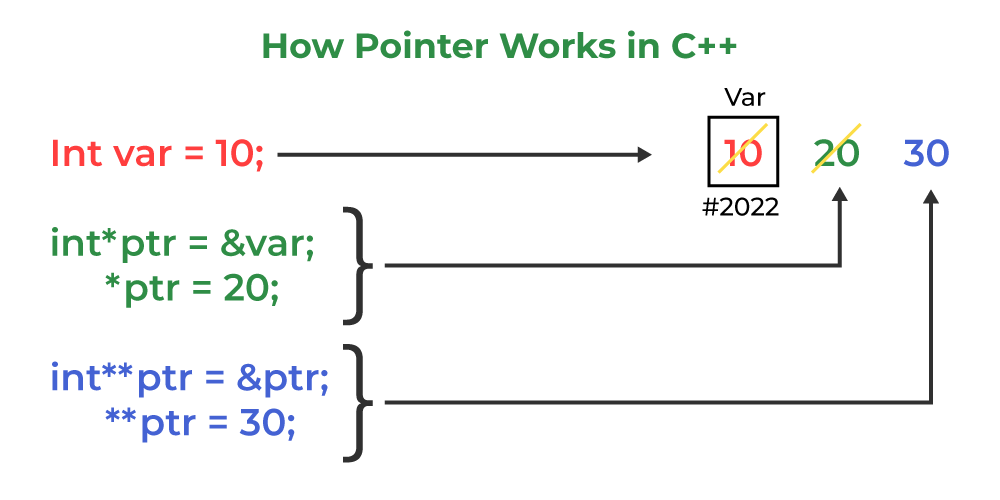
Declaring a Pointer to Pointer is similar to declaring a pointer in C++. The difference is we have to use an additional * operator before the name of a Pointer in C++.
Syntax of a Pointer to Pointer(Double Pointer) in C++:
data_type_of_pointer **name_of_variable = & normal_pointer_variable;
Example:
Value of variable :- 169
Value of variable using single pointer :- 169
Value of variable using double pointer :- 169
The below diagram explains the concept of Double Pointers:
The above diagram shows the memory representation of a pointer to a pointer. The first pointer ptr1 stores the address of the variable and the second pointer ptr2 stores the address of the first pointer.
In the C++ programming language double pointer behave similarly to a normal pointer. So, the size of the variable of the double-pointer and the size of the normal pointer variable is always equal.
Below is a C++ program to check the size of a double pointer:
 Size of normal Pointer: 8
 Size of double Pointer: 8
Note: The output of the above code also depends on the type of machine which is being used. The size of a pointer is not fixed in the C++ programming language and it totally depends on other factors like CPU architecture and OS used. Usually, for a 64-bit Operating System, a size of 8 bytes memory and for a 32-bit Operating system, a size of 4 bytes memory is assigned.