|
VOOZH | about |
|
VOOZH | about |
In C/C++, precedence of Prefix ++ (or Prefix --) has same priority than dereference (*) operator, and precedence of Postfix ++ (or Postfix --) is higher than both Prefix ++ and *. If p is a pointer then *p++ is equivalent to *(p++) and ++*p is equivalent to ++(*p) (both Prefix ++ and * are right associative).
Program 1:
For example, program 1 prints 'h' and program 2 prints 'e'.
h
Program 2:
e
Joe's Last Name is Donaldson
Here are some of the programs along with the concept which will help you in understanding the concept better.
When pre/post increment/decrement are used in statements with more than one operand then you have to take care of some rules.
Rule 1. When evaluating pre-increment value should be incremented first and will be assigned at the end of evaluating all the operands.
example :
Now take some time and think of the output of the above program.
If You are thinking that the output should be 4 then you are wrong. The output will be 5.
Here's the explanation
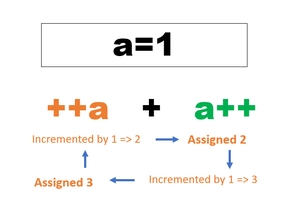
1. pre-increment increments the value first and then assigns it. here ++a is incremented to 2 but is not assigned because a++ is remaining.
2. Then a++ is assigned 2 and then it is incremented to 3. Now the value of a is 3.
3. This final value will be assigned to ++a because pre-increment values are assigned at the last.
4. So the output will be 3+2= 5.
If you think that you understood the concept then try the next example:
What do you think can be the answer to this example?
If you think what is the difference between this and the previous example then I must tell you that the difference is in the position of pre-increment and post-increment. And the output will also be changed. You can run this program to check the output.
The output will be 4.
Here's the explanation:
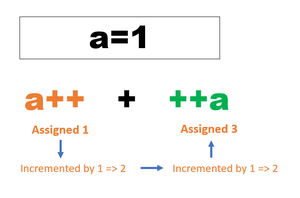
1. First the post-increment will be evaluated. It will be assigned 1 and then incremented to 2.
2. then pre- increment will be incremented to 3 and then assigned to 3.
So the sum of the assigned values is 1+3 = 4
If you like this post then hit the like button and share it with your fellow mates and friends.
- This post has been improved by Triangleofcoding