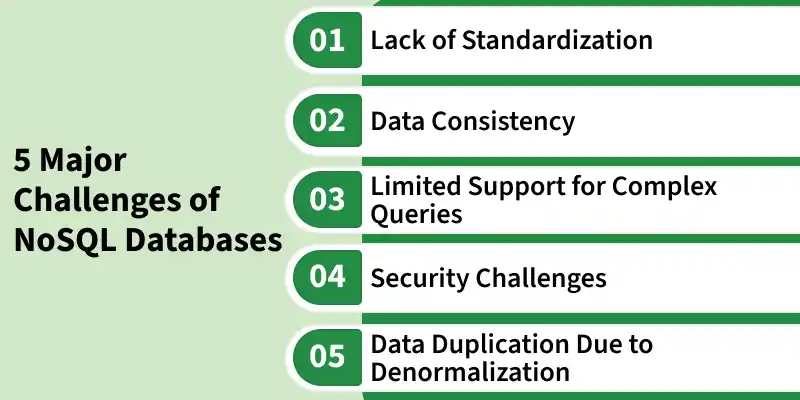
NoSQL databases are widely used for handling large and unstructured data because of their flexibility and scalability. However, they also have certain limitations and challenges compared to relational databases.
They may lack strong consistency compared to relational databases.
Standardization is limited because different NoSQL databases use different models.
Complex queries and joins are harder to perform.
Data duplication may occur due to denormalization.
Different NoSQL databases use different data models, architectures and query languages. Unlike relational databases that commonly use SQL, NoSQL systems do not follow a single standard query language.
Different databases use different syntaxes and structures.
Developers must learn separate technologies for each database.
Switching from one NoSQL database to another can be difficult.
Examples:
MongoDB uses a document-based model and MongoDB Query Language (MQL).
Apache Cassandra uses a wide-column model and Cassandra Query Language (CQL).
Redis mainly works as a key-value database.
2. Data Consistency
Many NoSQL databases prioritize scalability and availability over strong consistency. As a result, they often follow the principle of eventual consistency instead of immediate consistency.
Data updates may not appear instantly across all servers.
Temporary inconsistencies can occur in distributed systems.
Synchronizing data across multiple nodes becomes challenging.
Examples:
Apache Cassandra commonly follows eventual consistency in distributed environments.
Older versions of MongoDB had limited multi-document transaction support compared to relational databases.
3. Limited Support for Complex Queries
Some NoSQL databases are not optimized for advanced querying operations and relational data handling.
Limited support for joins and relationships.
Complex queries may require additional application-side logic.
Performing multi-table operations efficiently can be difficult.
Examples:
Redis is highly optimized for fast key-value access but not for complex relational queries.
MongoDB supports aggregation pipelines, but joins are still more limited compared to SQL databases.
4. Security Challenges
Managing security in NoSQL databases can become difficult, especially in large-scale distributed environments.
Some databases provide limited built-in security mechanisms.
Access control and authentication may require extra configuration.
Improper configuration can increase security vulnerabilities.
Monitoring security across distributed systems requires additional effort.
5. Data Duplication Due to Denormalization
NoSQL databases often use denormalization to improve read performance and scalability. This can lead to data duplication.
The same data may be stored in multiple locations.
Storage requirements may increase significantly.
Updating duplicate data can become difficult.
Example:
In MongoDB, related data is often embedded inside documents instead of using normalized tables.