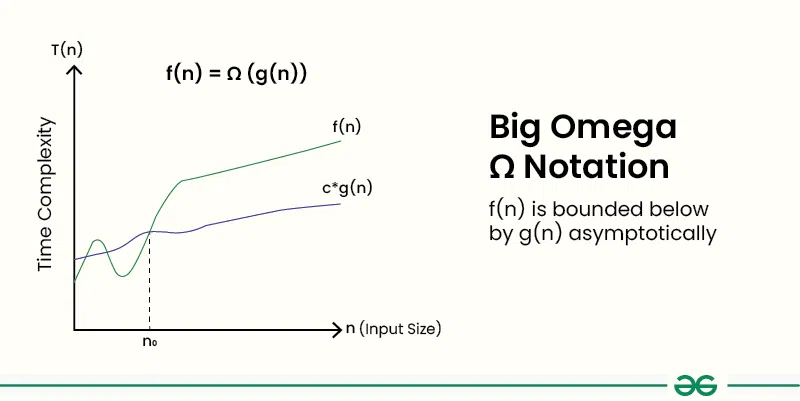
In the analysis of algorithms, asymptotic notations are used to denote a lower bound on asymptotic time taken by algorithm.
- It analyses the best-case situation of algorithm. It provides a equal orlower limit on the time taken by an algorithm in terms of the size of the input.
- Definition : Given two functions g(n) and f(n), we say that f(n) =Ω(g(n)), if there exists constants c > 0 and n0 >= 0 such that f(n) >= c*g(n) for all n >= n0. In simpler terms, f(n) is Ω(g(n)) if f(n) will always grow faster than c*g(n) for all n >= n0 where c and n0 are constants.
- We use it when we want to represent that the algorithm will take at least a certain amount of time or space.
- For any algorithm, we can say that its time complexity is Ω(1) as it represents a constant value and in this notation, we only have to guarantee a lower bound. However it is always recommended to find as close lower bound as possible.
👁 big-omega-imageHow to Determine Big-Omega Ω Notation?
In simple language, Big-Omega Ω notation specifies the asymptotic lower bound for a function f(n). It bounds the growth of the function from below as the input grows infinitely large.
- Break the algorithm into smaller segments such that each segment has a certain runtime complexity.
- Find the number of operations performed for each segment(in terms of the input size) assuming the given input is such that the program takes the least amount of time.
- Add up all the operations and simplify it, let's say it is f(n).
- Remove all the constants and choose the term having the least order or any other function which is always less than f(n) when n tends to infinity.
Example of Big-Omega Ω Notation:
Consider an example to print all the possible pairs of an array. The idea is to run two nested loops to generate all the possible pairs of the given array:
Output1 2
1 3
2 1
2 3
3 1
3 2
In this example, it is evident that the print statement gets executed n2 times. When the input range tends to infinity therefore, the best-case running time of this program can be Ω(n2),Ω(log n), Ω(n), Ω(1), or any function g(n) which is less than or equal to n2 when n tends to infinity. However it is recommended to always use the closest lower bound to give a good idea about the time.
Big O vs Big Ω (Omega) vs θ (Theta)
Below is a table comparing Big O notation, Ω (Omega) notation, and θ (Theta) notation:
| Notation | Definition | Explanation |
|---|
| Big O (O) | f(n) ≤ C * g(n) for all n ≥ n0 | Describes the upper bound of the algorithm's running time. Used most of the time. |
| Ω (Omega) | f(n) ≥ C * g(n) for all n ≥ n0 | Describes the lower bound of the algorithm's running time . Used less |
| θ (Theta) | C1 * g(n) ≤ f(n) ≤ C2 * g(n) for n ≥ n0 | Describes both the upper and lower bounds of the algorithm's running time. Also used a lot more and preferred over Big O if we can find an exact bound. |
In each notation:
- f(n) represents the function being analyzed, typically the algorithm's time complexity.
- g(n) represents a specific function that bounds f(n).
- C, C1, and C2 are constants.
- n0 is the minimum input size beyond which the inequality holds.