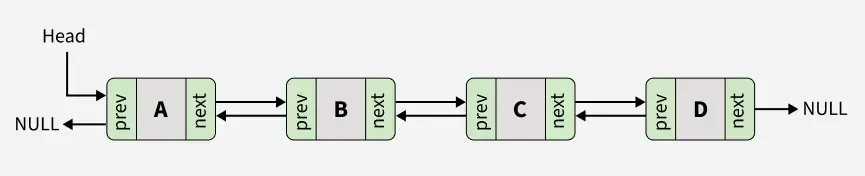
A linked list is a linear data structure, in which the elements are not stored at contiguous memory locations. The elements in a linked list are linked using pointers as shown in the below image:
👁 linked-list Applications of Linked Lists in Computer Science Data Structures : Implement stacks, queues, and adjacency lists in graphs. Memory Management : Dynamic memory allocation using free blocks. File & Directory Management : Maintain directories, symbol tables, and sparse matrices. Mathematical Operations : Long integer arithmetic, polynomial manipulation. Image & Signal Processing : Represent images, pixels, or signals. Operating Systems : Task scheduling, process management. Compilers : Symbol table management. Real-World Applications Image viewer, web browser, music player: Navigate previous/next items. GPS & Robotics: Manage routes and robot control systems. Undo/Redo functionality: Represent actions in applications. File systems & simulations : Store hierarchical directories or system states. Speech recognition & polynomial representation: Each node represents an element. Circular Linked Lists Efficient queues and cyclic operations (e.g., OS task scheduling). Used in databases, networking buffers, video/audio streaming, and games. Traffic light control systems: Cycle through phases repeatedly. Doubly Linked Lists Undo/Redo, back/forward buttons in browsers. Most recently used (MRU) lists. Game objects, networking, graph algorithms. OS process scheduling (traverse forward/backward efficiently). Recent Articles on Linked List