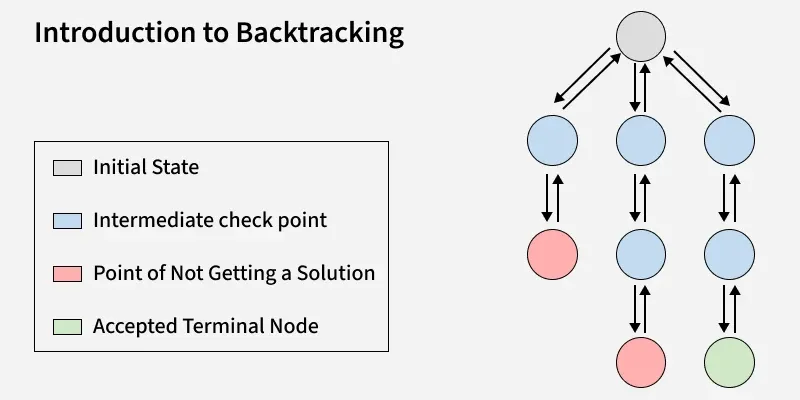
Backtracking algorithms are like problem-solving strategies that help explore different options to find the solution.
- Work by trying out different paths and if one doesn't work, then backtrack and try another until he right one is found. It's like solving a puzzle by testing different pieces until they fit together perfectly.
- Useful for problems where you must generate all valid combinations, permutations, or subsets under constraints.
👁 frame_3105Basics
- Introduction
- Backtracking vs Branch and Bound
Standard Problems
Easy Problems
Medium Problems
Hard Problems
Quick Links :
What is Backtracking Algorithm?
Backtracking is a problem-solving algorithmic technique that involves finding a solution incrementally by trying different options and undoing them if they lead to a dead end.
It is commonly used in situations where you need to explore multiple possibilities to solve a problem, like searching for a path in a maze or solving puzzles like Sudoku. When a dead end is reached, the algorithm backtracks to the previous decision point and explores a different path until a solution is found or all possibilities have been exhausted.
How Does a Backtracking Algorithm Work?
A backtracking algorithm works by recursively exploring all possible solutions to a problem. It starts by choosing an initial solution, and then it explores all possible extensions of that solution. If an extension leads to a solution, the algorithm returns that solution. If an extension does not lead to a solution, the algorithm backtracks to the previous solution and tries a different extension.
The following is a general outline of how a backtracking algorithm works:
- Choose an initial solution.
- Explore all possible extensions of the current solution.
- If an extension leads to a solution, return that solution.
- If an extension does not lead to a solution, backtrack to the previous solution and try a different extension.
- Repeat steps 2-4 until all possible solutions have been explored.
Example of Backtracking Algorithm
Example: Finding the shortest path through a maze
Input: A maze represented as a 2D array, where 0 represents an open space and 1 represents a wall.
Algorithm:
- Start at the starting point.
- For each of the four possible directions (up, down, left, right), try moving in that direction.
- If moving in that direction leads to the ending point, return the path taken.
- If moving in that direction does not lead to the ending point, backtrack to the previous position and try a different direction.
- Repeat steps 2-4 until the ending point is reached or all possible paths have been explored.
When to Use a Backtracking Algorithm?
Backtracking algorithms are best used to solve problems that have the following characteristics:
- There are multiple possible solutions to the problem.
- The problem can be broken down into smaller subproblems.
- The subproblems can be solved independently.
Applications of Backtracking Algorithm
Backtracking algorithms are used in a wide variety of applications, including:
- Solving puzzles (e.g., Sudoku, crossword puzzles)
- Finding the shortest path through a maze
- Scheduling problems
- Resource allocation problems
- Network optimization problems
- Combinatorial problems, such as generating permutations, combinations, or subsets.