|
VOOZH | about |
|
VOOZH | about |
Prerequisite - Resource Allocation Graph (RAG), Banker’s Algorithm, Program for Banker’s Algorithm
Banker's Algorithm is a resource allocation and deadlock avoidance algorithm. This algorithm test for safety simulating the allocation for predetermined maximum possible amounts of all resources, then makes an “s-state” check to test for possible activities, before deciding whether allocation should be allowed to continue.
In simple terms, it checks if allocation of any resource will lead to deadlock or not, OR if is it safe to allocate a resource to a process and if not then resource is not allocated to that process. Determining a safe sequence(even if there is only 1) will assure that system will not go into deadlock.
Banker's algorithm is generally used to find if a safe sequence exist or not. But here we will determine the total number of safe sequences and print all safe sequences.
How does the Banker's Algorithm work?
The Banker's Algorithm works by maintaining a matrix of resources and processes. Each row represents a process, and each column represents a resource. The matrix contains information about the current state of the system, including the maximum number of resources each process needs, the number of resources currently allocated to each process, and the number of resources available in the system.
: What is the purpose of the Banker's Algorithm?
A: The purpose of the Banker's Algorithm is to prevent deadlock, a situation where two or more processes are blocked, waiting for each other to release resources they need in order to proceed. Deadlock can cause a system to become unresponsive and may require a reboot to recover.
The data structure used are:
Example:
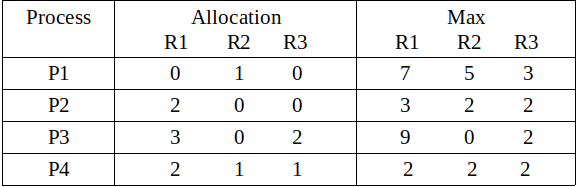
Input:
Output: Safe sequences are:
P2--> P4--> P1--> P3
P2--> P4--> P3--> P1
P4--> P2--> P1--> P3
P4--> P2--> P3--> P1

There are total 4 safe-sequences
Explanation:
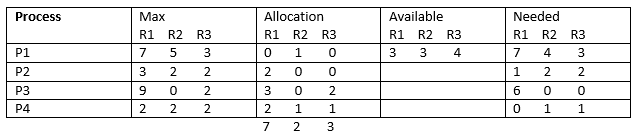
Total resources are R1 = 10, R2 = 5, R3 = 7 and allocated resources are R1 = (0+2+3+2 =) 7, R2 = (1+0+0+1 =) 2, R3 = (0+0+2+1 =) 3. Therefore, remaining resources are R1 = (10 - 7 =) 3, R2 = (5 - 2 =) 3, R3 = (7 - 3 =) 4.
Remaining available = Total resources - allocated resources
and
Remaining need = max - allocated
So, we can start from either P2 or P4. We can not satisfy remaining need from available resources of either P1 or P3 in first or second attempt step of Banker's algorithm. There are only four possible safe sequences.
These are :
 P2--> P4--> P1--> P3
 P2--> P4--> P3--> P1
 P4--> P2--> P1--> P3
 P4--> P2--> P3--> P1
Implementation:
Safe sequences are:
P2--> P4--> P1--> P3
P2--> P4--> P3--> P1
P4--> P2--> P1--> P3
P4--> P2--> P3--> P1

There are total 4 safe-sequences
Time complexity: O(P*R)
Auxiliary Space: O(P*R)
FAQ:
Q1: What are the advantages of using the Banker's Algorithm?
Employing the Banker's Algorithm has various benefits such as averting a state of deadlock and enabling every process to finish its execution seamlessly. This could aid in boosting the overall stability and dependability of the system.
Q2: What are the limitations of the Banker's Algorithm?
The Banker's Algorithm has certain limitations as it assumes resources to be fixed in number that may not be feasible in several circumstances. Additionally, the algorithm supposes that a process's maximum resource requirements are known beforehand, which may not hold true every time.
Q3: What are some real-world examples of where the Banker's Algorithm is used?
The Banker's Algorithm finds widespread usage across operating systems, resource allocation systems, manufacturing control systems, and airline reservation systems.