|
VOOZH | about |
|
VOOZH | about |
The main application of Binary Heap is to implement a priority queue. Binomial Heap is an extension of Binary Heap that provides faster union or merge operation with other operations provided by Binary Heap.
A Binomial Heap is a collection of Binomial Trees
What is a Binomial Tree?
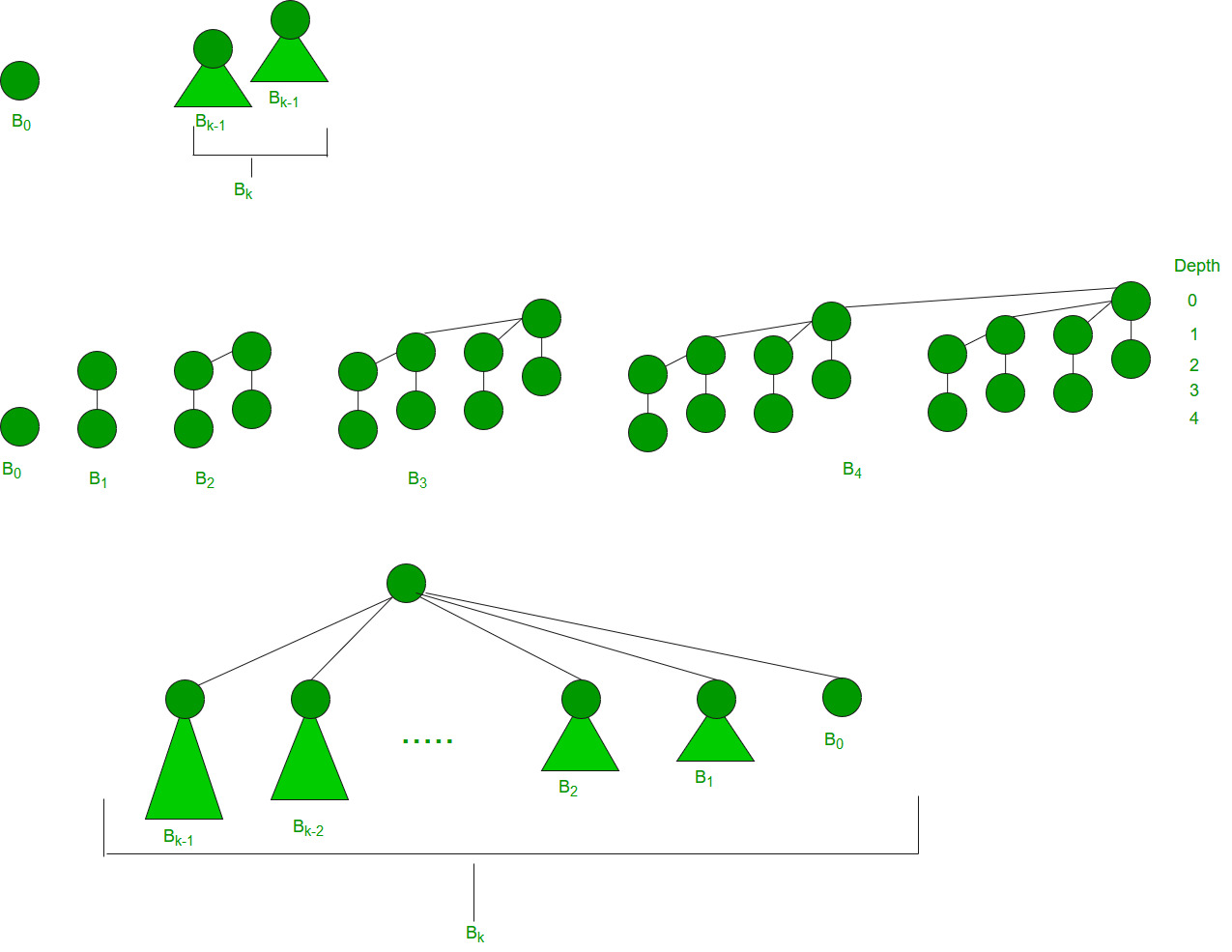
A Binomial Tree of order 0 has 1 node. A Binomial Tree of order k can be constructed by taking two binomial trees of order k-1 and making one the leftmost child of the other.
A Binomial Tree of order k the has following properties.
k = 0 (Single Node)
 o
k = 1 (2 nodes)
[We take two k = 0 order Binomial Trees, and
make one as a child of other]
 o
 /
o
k = 2 (4 nodes)
[We take two k = 1 order Binomial Trees, and
make one as a child of other]
 o
 / \
 o o
 /
o
k = 3 (8 nodes)
[We take two k = 2 order Binomial Trees, and
make one as a child of other]
 o
 / | \
 o o o
 / \ |
 o o o
 /
o
The following diagram is referred to form the 2nd Edition of the CLRS book.
Binomial Heap:
A Binomial Heap is a set of Binomial Trees where each Binomial Tree follows the Min Heap property. And there can be at most one Binomial Tree of any degree.
Examples Binomial Heap:
12------------10--------------------20
 / \ / | \
 15 50 70 50 40
 | / | |
 30 80 85 65
 |
 100
A Binomial Heap with 13 nodes. It is a collection of 3
Binomial Trees of orders 0, 2, and 3 from left to right.
 10--------------------20
 / \ / | \
 15 50 70 50 40
 | / | |
 30 80 85 65
 |
 100
A Binomial Heap with 12 nodes. It is a collection of 2
Binomial Trees of orders 2 and 3 from left to right.
Programs to implement Binomial heap:
Binary Representation of a number and Binomial Heaps
A Binomial Heap with n nodes has the number of Binomial Trees equal to the number of set bits in the binary representation of n. For example, let n be 13, there are 3 set bits in the binary representation of n (00001101), hence 3 Binomial Trees. We can also relate the degree of these Binomial Trees with positions of set bits. With this relation, we can conclude that there are O(Logn) Binomial Trees in a Binomial Heap with 'n' nodes.
Operations of Binomial Heap:
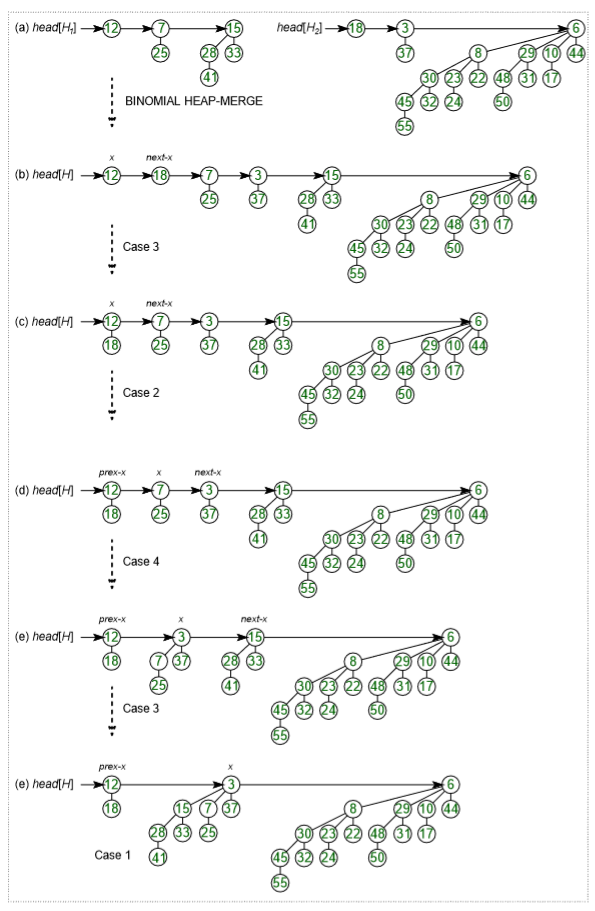
The main operation in Binomial Heap is a union(), all other operations mainly use this operation. The union() operation is to combine two Binomial Heaps into one. Let us first discuss other operations, we will discuss union later.
Time Complexity Analysis:
Operations | Binary Heap | Binomial Heap | Fibonacci Heap |
Procedure | Worst-case | Worst-case | Amortized |
Making Heap | Θ(1) | Θ(1) | Θ(1) |
Inserting a node | Θ(log(n)) | O(log(n)) | Θ(1) |
Finding Minimum key | Θ(1) | O(log(n)) | O(1) |
Extract-Minimum key | Θ(log(n)) | Θ(log(n)) | O(log(n)) |
Union or merging | Θ(n) | O(log(n)) | Θ(1) |
Decreasing a Key | Θ(log(n)) | Θ(log(n)) | Θ(1) |
Deleting a node | Θ(log(n)) | Θ(log(n)) | O(log(n)) |
How to represent Binomial Heap?
A Binomial Heap is a set of Binomial Trees. A Binomial Tree must be represented in a way that allows sequential access to all siblings, starting from the leftmost sibling (We need this in and extracting() and delete()). The idea is to represent Binomial Trees as the leftmost child and right-sibling representation, i.e., every node stores two pointers, one to the leftmost child and the other to the right sibling.