|
VOOZH | about |
|
VOOZH | about |
BK-Tree is a data structure used for efficient searching of words that are close to a target word in terms of their Levenshtein distance (or edit distance). It is a tree-like data structure, where each node represents a word and its children represent words that are one edit distance away.
BK Tree or Burkhard Keller Tree is a data structure that is used to perform spell check based on the Edit Distance (Levenshtein distance) concept. BK trees are also used for approximate string matching. Various auto-correct features in many software can be implemented based on this data structure.
Pre-requisites : Edit distance Problem
Metric tree
Let's say we have a dictionary of words and then we have some other words which are to be checked in the dictionary for spelling errors. We need to have a collection of all words in the dictionary which are very close to the given word. For instance, if we are checking the word "ruk" we will have {"truck","buck","duck",......}. Therefore, spelling mistakes can be corrected by deleting a character from the word or adding a new character in the word, or replacing the character in the word with an appropriate one. Therefore, we will be using the edit distance as a measure for correctness and matching of the misspelled word from the words in our dictionary.
Now, let's see the structure of our BK Tree. Like all other trees, BK Tree consists of nodes and edges. The nodes in the BK Tree will represent the individual words in our dictionary and there will be exactly the same number of nodes as the number of words in our dictionary. The edge will contain some integer weight that will tell us about the edit distance from one node to another. Let's say we have an edge from node u to node v having some edge-weight w, then w is the edit distance required to turn the string u to v.
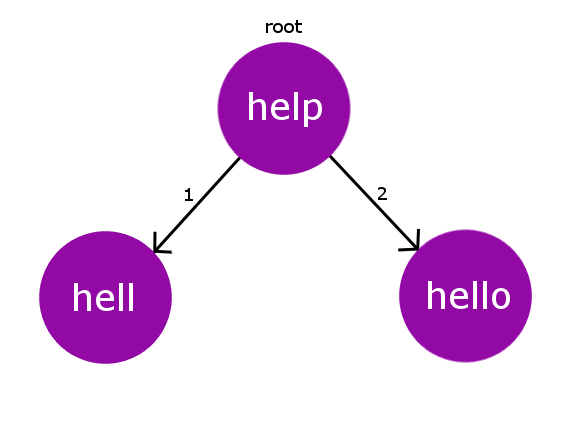
Consider our dictionary with words: { "help" , "hell" , "hello"}. Therefore, for this dictionary our BK Tree will look like the below one.
👁 17554971_1350416058376194_212983783_n
Every node in the BK Tree will have exactly one child with same edit-distance. In case, if we encounter some collision for edit-distance while inserting, we will then propagate the insertion process down the children until we find an appropriate parent for the string node.
Every insertion in the BK Tree will start from our root node. Root node can be any word from our dictionary.
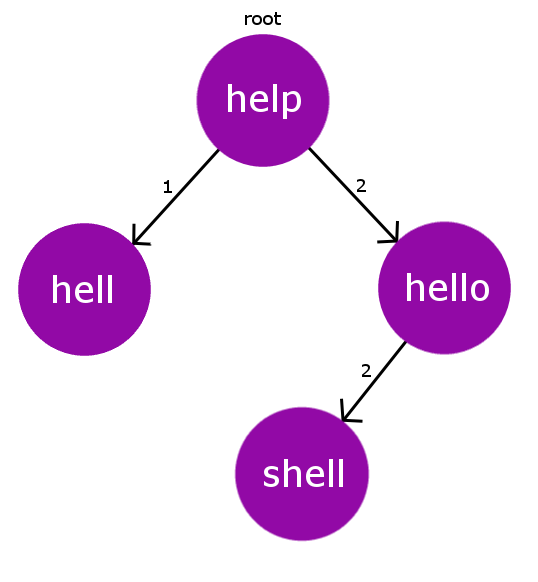
For example, let's add another word "shell" to the above dictionary. Now our Dict[] = {"help" , "hell" , "hello" , "shell"}. It is now evident that "shell" has same edit-distance as "hello" has from the root node "help" i.e 2. Hence, we encounter a collision. Therefore, we deal this collision by recursively doing this insertion process on the pre-existing colliding node.
So, now instead of inserting "shell" at the root node "help", we will now insert it to the colliding node "hello". Therefore, now the new node "shell" is added to the tree and it has node "hello" as its parent with the edge-weight of 2(edit-distance). Below pictorial representation describes the BK Tree after this insertion.
👁 17555358_1350416071709526_1845256507_n
So, till now we have understood how we will build our BK Tree. Now, the question arises that how to find the closest correct word for our misspelled word? First of all, we need to set a tolerance value. This tolerance value is simply the maximum edit distance from our misspelled word to the correct words in our dictionary. So, to find the eligible correct words within the tolerance limit, Naive approach will be to iterate over all the words in the dictionary and collect the words which are within the tolerance limit. But this approach has O(n*m*n) time complexity(n is the number of words in dict[], m is average size of correct word and n is length of misspelled word) which times out for larger size of dictionary.
Therefore, now the BK Tree comes into action. As we know that each node in BK Tree is constructed on basis of edit-distance measure from its parent. Therefore, we will directly be going from root node to specific nodes that lie within the tolerance limit. Lets, say our tolerance limit is TOL and the edit-distance of the current node from the misspelled word is dist. Therefore, now instead of iterating over all its children we will only iterate over its children that have edit distance in range
[dist-TOL , dist+TOL]. This will reduce our complexity by a large extent. We will discuss this in our time complexity analysis.
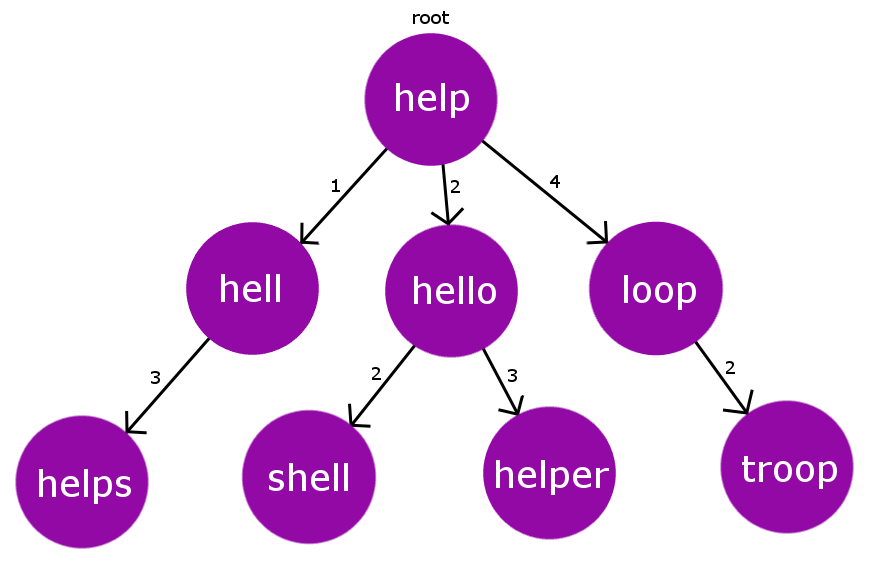
Consider the below constructed BK Tree.
👁 17555345_1350416661709467_503833975_n
Let's say we have a misspelled word "oop" and the tolerance limit is 2. Now, we will see how we will collect the expected correct for the given misspelled word.
Iteration 1: We will start checking the edit distance from the root node. D("oop" -> "help") = 3. Now we will iterate over its children having edit distance in range [ D-TOL , D+TOL ] i.e [1,5]
Iteration 2: Let's start iterating from the highest possible edit distance child i.e node "loop" with edit distance 4.Now once again we will find its edit distance from our misspelled word. D("oop","loop") = 1.
here D = 1 i.e D <= TOL , so we will add "loop" to the expected correct word list and process its child nodes having edit distance in range [D-TOL,D+TOL] i.e [1,3]
Iteration 3: Now, we are at node "troop" . Once again we will check its edit distance from misspelled word. D("oop","troop")=2 .Here again D <= TOL , hence again we will add "troop" to the expected correct word list.
We will proceed the same for all the words in the range [D-TOL,D+TOL] starting from the root node till the bottom most leaf node. This, is similar to a DFS traversal on a tree, with selectively visiting the child nodes whose edge weight lie in some given range.
Therefore, at the end we will be left with only 2 expected words for the misspelled word "oop" i.e {"loop","troop"}
similar words in dictionary for : ops:
oops
pop
Correct words in dictionary for helt:
hell
help
shell
fell
felt
halt
Time Complexity: It is quite evident that the time complexity majorly depends on the tolerance limit. We will be considering tolerance limit to be 2. Now, roughly estimating, the depth of BK Tree will be log n, where n is the size of dictionary. At every level we are visiting 2 nodes in the tree and perfor
g edit distance calculation. Therefore, our Time Complexity will be O(L1*L2*log n), here L1 is the average length of word in our dictionary and L2 is the length of misspelled. Generally, L1 and L2 will be small.
Auxiliary Space: The space complexity of the above implementation is O(L1*L2) where L1 is the number of words in the dictionary and L2 is the maximum length of the word.