|
VOOZH | about |
|
VOOZH | about |
A Cartesian tree is a tree data structure created from a set of data that obeys the following structural invariants:
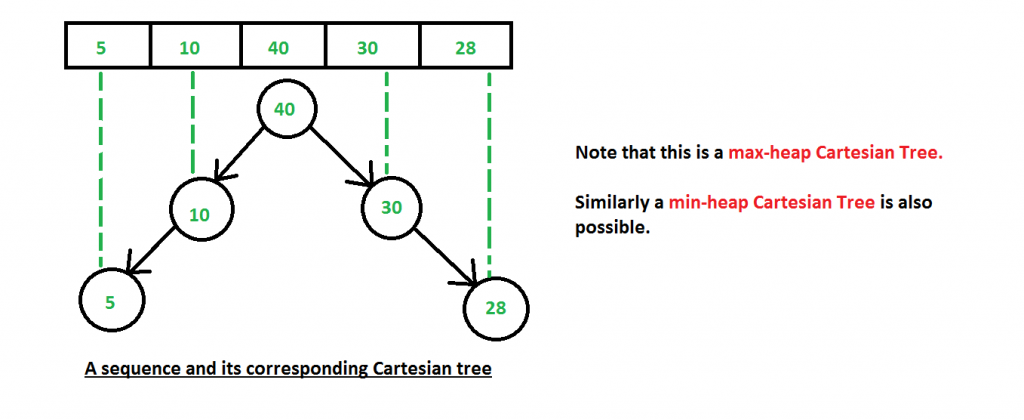
Suppose we have an input array- {5,10,40,30,28}. Then the max-heap Cartesian Tree would be.
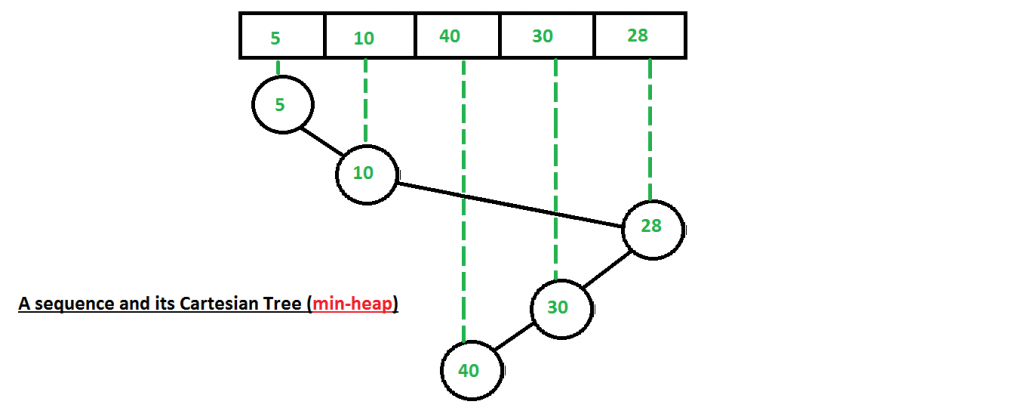
A min-heap Cartesian Tree of the above input array will be-
Note:
Cartesian tree of a sequence of distinct numbers is always unique.
We will prove this using induction. As a base case, empty tree is always unique. For the inductive case, assume that for all trees containing n' < n elements, there is a unique Cartesian tree for each sequence of n' nodes. Now take any sequence of n elements. Because a Cartesian tree is a min-heap, the smallest element of the sequence must be the root of the Cartesian tree. Because an inorder traversal of the elements must yield the input sequence, we know that all nodes to the left of the min element must be in its left subtree and similarly for the nodes to the right. Since the left and right subtree are both Cartesian trees with at most n-1 elements in them (since the min element is at the root), by the induction hypothesis there is a unique Cartesian tree that could be the left or right subtree. Since all our decisions were forced, we end up with a unique tree, completing the induction.
How to construct Cartesian Tree?
A O(n2) solution for construction of Cartesian Tree is discussed here (Note that the above program here constructs the “special binary tree” (which is nothing but a Cartesian tree)
A O(nlogn) Algorithm :
It's possible to build a Cartesian tree from a sequence of data in O(NlogN) time on average. Beginning with the empty tree,
Scan the given sequence from left to right adding new nodes as follows:
Output:
Inorder traversal of the constructed tree :
5 10 40 30 28
Time Complexity :
At first look, the code seems to be taking O(n2) time as there are two loop in buildCartesianTree(). But actually, it takes O(NlogN) time in average and O(n^2) for sorted preorder traversal.
Auxiliary Space:
We declare a structure for every node as well as three extra arrays- leftchild[], rightchild[], parent[] to hold the indices of left-child, right-child, parent of each value in the input array. Hence the overall O(4*n) = O(n) extra space.
Application of Cartesian Tree
References:
http://wcipeg.com/wiki/Cartesian_tree