|
VOOZH | about |
|
VOOZH | about |
A Cellular Automaton is a discrete model similar to any other automaton which has its own start state(s) and a set of rules.
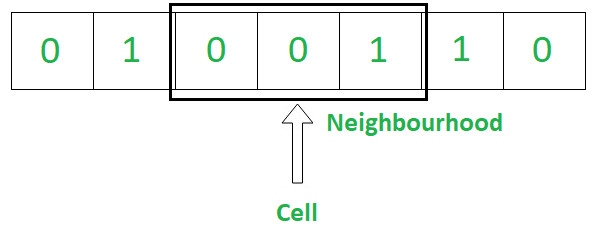
👁 ImageA cellular automaton is a model of a system of "cell" objects with the following characteristics :
- The cells live on a grid which can be either 1D or even multi-dimensional
- Each cell has a state. The number of state possibilities is typically finite. The simplest example has the two possibilities of 1 and 0
- Each cell has a neighbourhood and it is typically a list of adjacent cells
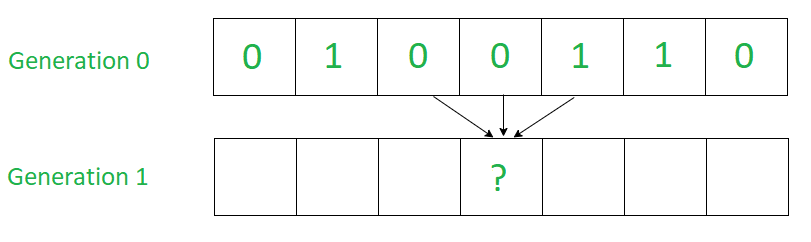
The working principle of the cellular automata is shown below:
2. Rule 90:
Rule 90 is an elementary cellular automaton that consists of a one-dimensional array of cells, each of which can hold either a 0 or a 1 value. Each cell is the exclusive or(XOR) of its two neighbours.
| Current State | 111 | 011 | 101 | 100 | 011 | 010 | 001 | 000 |
| Next State | 0 | 1 | 0 | 1 | 1 | 0 | 1 | 0 |
If we concatenate the Next State into a single binary number and convert it to decimal (01011010)2, it becomes 90, hence we get the name Rule 90.
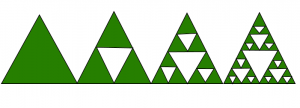
3. When the initial state has a single nonzero cell, this diagram has the appearance of the Sierpiński triangle.
👁 Sierpinski_triangle1Implementation of Sierpiński triangle:
The rules of Rule 90 Cellular Automata are as follows:
 Rule 1: 0 0 0 -> sets cell to: 0
 Rule 2: 0 0 1 -> sets cell to: 1
 Rule 3: 0 1 0 -> sets cell to: 0
 Rule 4: 0 1 1 -> sets cell to: 1
 Rule 5: 1 0 0 -> sets cell to: 1
 Rule 6: 1 0 1 -> sets cell to: 0
 Rule 7: 1 1 0 -> sets cell to: 1
 Rule 8: 1 1 1 -> sets cell to: 0

 SIERPINSKI TRIANGLE

 ■
 ■ ■
 ■ ■
 ■ ■ ■ ■
 ■ ■
 ■ ■ ■ ■
 ■ ■ ■ ■
 ■ ■ ■ ■ ■ ■ ■ ■
 ■ ■
 ■ ■ ■ ■
 ■ ■ ■ ■
 ■ ■ ■ ■ ■ ■ ■ ■
 ■ ■ ■ ■
 ■ ■ ■ ■ ■ ■ ■ ■
 ■ ■ ■ ■ ■ ■ ■ ■
 ■ ■ ■ ■ ■ ■ ■ ■ ■ ■ ■ ■ ■ ■ ■ ■