|
VOOZH | about |
|
VOOZH | about |
You are given an n * n matrix which represents a graph with n-vertices, check whether the input matrix represents a star graph or not.
Example:
Input : Mat[][] = {{0, 1, 0},
 {1, 0, 1},
 {0, 1, 0}}
Output : Star graph

Input : Mat[][] = {{0, 1, 0},
 {1, 1, 1},
 {0, 1, 0}}
Output : Not a Star graph
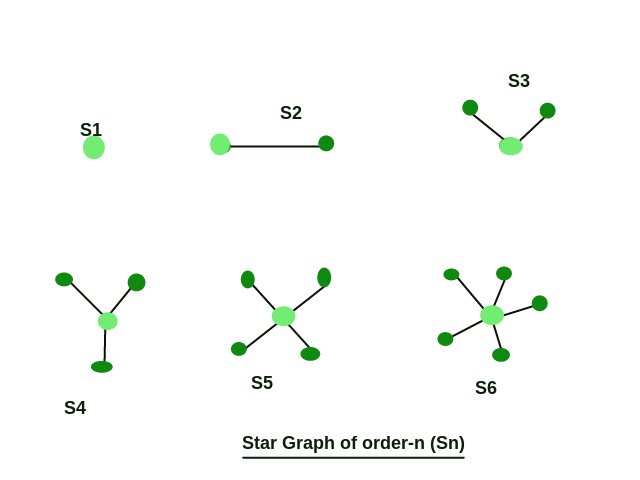
Star graph: Star graph is a special type of graph in which n-1 vertices have degree 1 and a single vertex have degree n - 1. This looks like n - 1 vertex is connected to a single central vertex. A star graph with total n - vertex is termed as Sn.
Here is an illustration for the star graph :
Approach: Just traverse whole matrix and record the number of vertices having degree 1 and degree n-1. If number of vertices having degree 1 is n-1 and number of vertex having degree n-1 is 1 then our graph should be a star graph other-wise it should be not.
Note:
Implementation:
Star Graph
Approach 2: Breath First Search:
The BFS approach of the code first initializes an integer array 'degree' of size 'size' to store the degree of each vertex in the graph. It then traverses the graph using two nested loops and calculates the degree of each vertex by counting the number of edges that are incident on the vertex. The degree of each vertex is stored in the corresponding position of the 'degree' array.
Next, the code searches for a center vertex of the graph. A center vertex is a vertex that is connected to all other vertices in the graph. The code checks the degree of each vertex in the 'degree' array and looks for a vertex whose degree is equal to the size of the graph minus one. If such a vertex is found, it is stored in the 'center' variable.
Star Graph
Time Complexity: O(size^2), where size is the size of the adjacency matrix.
Auxiliary Space: O(size), where size is the size of the adjacency matrix.