|
VOOZH | about |
|
VOOZH | about |
Given a binary tree, you need to check whether sum of all covered elements is equal to sum of all uncovered elements or not.
In a binary tree, a node is called Uncovered if it appears either on left boundary or right boundary. Rest of the nodes are called covered.
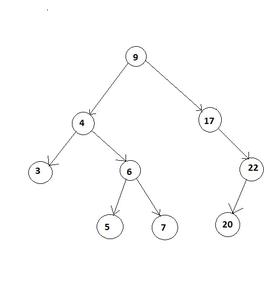
For example, consider below binary tree
In above binary tree,
Covered node: 6, 5, 7
Uncovered node: 9, 4, 3, 17, 22, 20

The output for this tree should be false as
sum of covered and uncovered node is not same
We strongly recommend you to minimize your browser and try this yourself first.
For calculating sum of Uncovered nodes we will follow below steps:
1) Start from root, go to left and keep going until left child is available, if not go to right child and again follow same procedure until you reach a leaf node.
2) After step 1 sum of left boundary will be stored, now for right part again do the same procedure but now keep going to right until right child is available, if not then go to left child and follow same procedure until you reach a leaf node.
After above 2 steps sum of all Uncovered node will be stored, we can subtract it from total sum and get sum of covered elements and check for equines of binary tree.
Output :
Sum of covered and uncovered is not same
Time Complexity: O(N), node will run for every new node.
Space Complexity: O(N), space is needed for every node.