|
VOOZH | about |
|
VOOZH | about |
Given four points in a 2-dimensional space we need to find out whether they make a parallelogram or not.
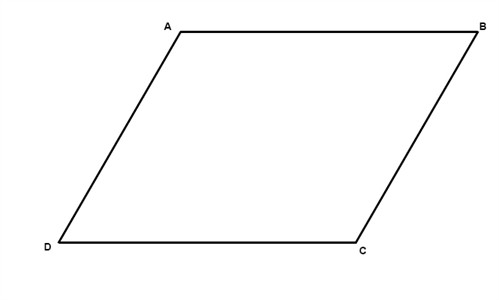
A parallelogram has four sides. Two opposite sides are parallel and are of same lengths.
Examples:
Points = [(0, 0), (4, 0), (1, 3), (5, 3)]
Above points make a parallelogram.
Points = [(0, 0), (2, 0), (4, 0), (2, 2)]
Above points does not make a parallelogram
as first three points itself are linear.
Problems for checking square and rectangle can be read from Square checking and Rectangle checking but in this problem, we need to check for the parallelogram. The main properties of the parallelogram are that opposite sides of parallelogram are parallel and of equal length and diagonals of parallelogram bisect each other. We use the second property to solve this problem. As there are four points, we can get total 6 midpoints by considering each pair. Now for four points to make a parallelogram, 2 of the midpoints should be equal and rest of them should be different. In below code, we have created a map, which stores pairs corresponding to each midpoint. After calculating all midpoints, we have iterated over the map and check the occurrence of each midpoint, If exactly one midpoint occurred twice and other have occurred once, then given four points make a parallelogram otherwise not.
Output:
Given points form a parallelogram
Time Complexity: O(p2logp) , where p is number of points
Auxiliary Space: O(p2), where p is number of points
Here is the C++ code implementation of this approach:
Output:
Given points form a parallelogram
Time Complexity: O(n^2logn) where n is the number of points
Auxiliary Space: O(n^2) since the map data structure is used to store the midpoints, and the worst-case number of midpoints that can be stored is n^2.