We know a tree is a non-linear data structure. It has no limitation on the number of children. A binary tree has a limitation as any node of the tree has at most two children: a left and a right child.
A complete binary tree is a special type of binary tree where all the levels of the tree are filled completely except the lowest level nodes which are filled from as left as possible.
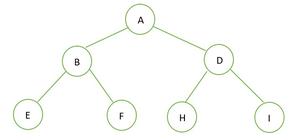
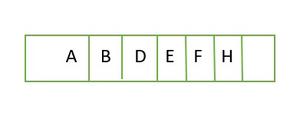
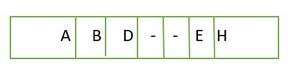
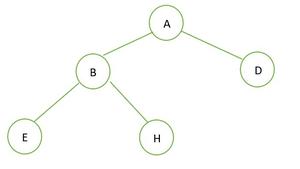
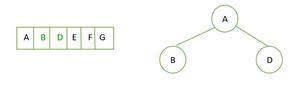
The height of the given binary tree is 2 and the maximum number of nodes in that tree is n= 2h+1-1 = 22+1-1 = 23-1 = 7. Hence we can conclude it is a perfect binary tree. Now for a complete binary tree, It is full up to height h-1 i.e.; 1, and the last level elements are stored in left to right order. Hence it is a complete Binary tree also. Here is the representation of elements when stored in an array
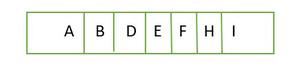
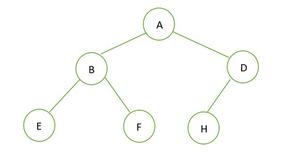
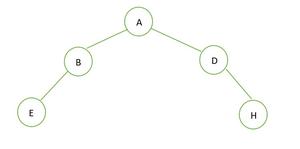
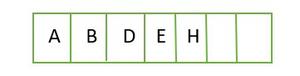
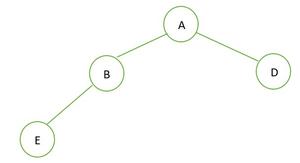
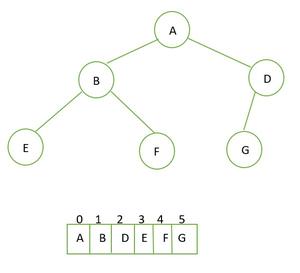
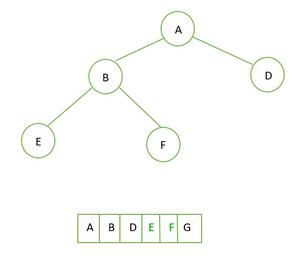
Height of the given binary tree is 2 and the maximum number of nodes that should be there are 2h+1 - 1 = 22+1 - 1 = 23 - 1 = 7. But the number of nodes in the tree is 6. Hence it is not a perfect binary tree. Now for a complete binary tree, It is full up to height h-1 i.e.; 1, and the last level element are stored in left to right order. Hence this is a complete binary tree. Store the element in an array and it will be like;
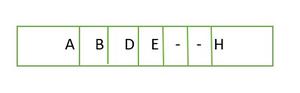
The height of the binary tree is 2 and the maximum number of nodes that can be there is 7, but there are only 5 nodes hence it is not a perfect binary tree. In case of a complete binary tree, we see that in the last level elements are not filled from left to right order. So it is not a complete binary tree.
In the given binary tree there is no node having degree 1, either 2 or 0 children for every node, hence it is a full binary tree.
For a complete binary tree, elements are stored in level by level and not from the leftmost side in the last level. Hence this is not a complete binary tree. The array representation is:
In the given binary tree there is no node having degree 1. Every node has a degree of either 2 or 0. Hence it is a full binary tree.
For a complete binary tree, elements are stored in a level by level manner and filled from the leftmost side of the last level. Hence this a complete binary tree. Below is the array representation of the tree:
In the given binary tree node B has degree 1 which violates the property of full binary tree hence it is not a full Binary tree
For a complete binary tree, elements are stored in level by level manner and filled from the leftmost side of the last level. Hence this is a complete binary tree. Array representation of the binary tree is:
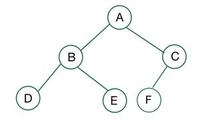
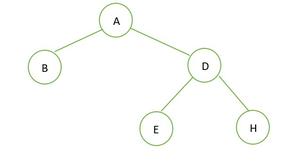
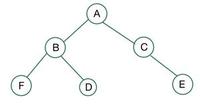
In the given binary tree node C has degree 1 which violates the property of a full binary tree hence it is not a full Binary tree
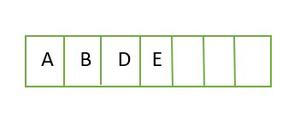
For a complete binary tree, elements are stored in level by level manner and filled from the leftmost side of the last level. Here node E violates the condition. Hence this is not a complete binary tree.
We know a complete binary tree is a tree in which except for the last level (say l)all the other level has (2l) nodes and the nodes are lined up from left to right side. It can be represented using an array. If the parent is it index i so the left child is at 2i+1 and the right child is at 2i+2.
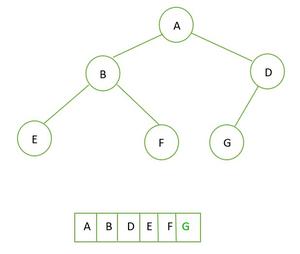
👁 Image Complete binary tree and its array representation
Algorithm:
For the creation of a Complete Binary Tree, we require a queue data structure to keep track of the inserted nodes.
Step 1: Initialize the root with a new node when the tree is empty.
Step 2: If the tree is not empty then get the front element
If the front element does not have a left child then set the left child to a new node
If the right child is not present set the right child as a new node
Step 3: If the node has both the children then pop it from the queue.
Step 4: Enqueue the new data.
Illustration:
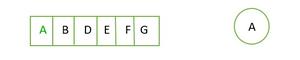
Consider the below array:
1. The 1st element will the root (value at index = 0)