|
VOOZH | about |
|
VOOZH | about |
Given two integers N and M denoting the dimensions of a chessboard, and two integers X and Y denoting the King's position, i.e. the cell (X, Y). The task is to find the number of cells the Queen can visit that are not visited by the King if it gets replaced by the King. The King visits all his adjacent cells and the Queen can move diagonally, horizontally, and vertically.
Examples:
Input: N = 8, M = 8, X = 1, Y = 1
👁 Image
Output: 18
Explanation:
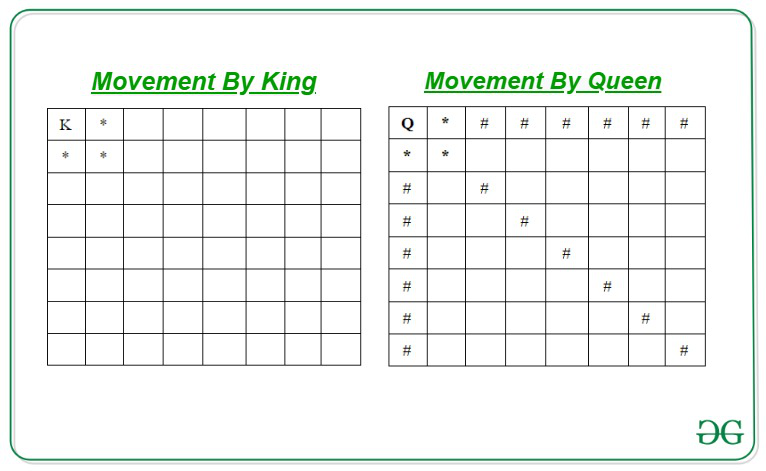
Below is the image to show the movement of King and Queen:
Suppose K represents King and * represents cells visited by the king and Q represents Queen and # represent the cells visited by the queen.
So, the total squares can be visited by the queen is 18.Input: N = 2, M = 1, X = 1, Y = 1
Output: 0
Approach: The idea is to first find the total number of positions that the Queen can visit. Then find the total number of positions that the King can visit. The number of cells that can only be visited by the Queen will be the number of cells the King can visit subtracted from the number of cells the Queen can visit. Follow the below steps to solve the problem:
If N - X > 0 and M - Y > 0, queenMoves = queenMoves + min(N - X, M - Y)
If X - 1 > 0 and Y - 1 > 0, queenMoves = queenMoves + min(Y - 1, X - 1)
If X - 1 > 0 and M - Y > 0, queenMoves = queenMoves + min(X - 1, M - Y)
If N - X > 0 and Y - 1 > 0, queenMoves = queenMoves + min(N - X, Y - 1)
At last, add the answer for horizontal and vertical movements as queenMoves = queenMoves + (N - 1) + (M - 1)
If X + 1 <= N, kingMoves = kingMoves + 1
If X - 1 > 0, kingMoves = kingMoves + 1
If Y + 1 <= M, kingMoves = kingMoves + 1
If Y - 1 > 0, kingMoves = kingMoves + 1
If X + 1 <= N and Y + 1 <= M, kingMoves = kingMoves + 1
If X + 1 <= N and Y - 1 > 0, kingMoves = kingMoves + 1
If X - 1 > 0 and Y - 1 > 0, kingMoves = kingMoves + 1
If X - 1 > 0 and Y + 1 <= M, kingMoves = kingMoves + 1
Below is the implementation of the above approach:
18
Time Complexity: O(1)
Auxiliary Space: O(1)