VOOZH about

URL: https://www.geeksforgeeks.org/dsa/de-bruijn-sequence-set-1/

⇱ De Bruijn sequence | Set 1 - GeeksforGeeks


  • Courses
  • Tutorials
  • Interview Prep

De Bruijn sequence | Set 1

Last Updated : 11 Jul, 2025

Given an integer n and a set of characters A of size k, find a string S such that every possible string on A of length n appears exactly once as a substring in S. Such a string is called de Bruijn sequence.

Examples: 

Input: n = 3, k = 2, A = {0, 1) 
Output: 0011101000 
All possible strings of length three (000, 001, 010, 011, 100, 101, 110 and 111) appear exactly once as sub-strings in A.

Input: n = 2, k = 2, A = {0, 1) 
Output: 01100 

Approach: 
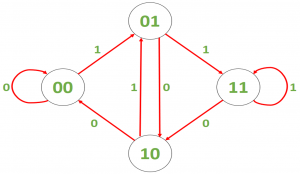
We can solve this problem by constructing a directed graph with kn-1 nodes with each node having k outgoing edges. Each node corresponds to a string of size n-1. Every edge corresponds to one of the k characters in A and adds that character to the starting string. 

For example, if n=3 and k=2, then we construct the following graph:
 

👁 Image

  • The node '01' is connected to node '11' through edge '1', as adding '1' to '01' (and removing the first character) gives us '11'.
  • We can observe that every node in this graph has equal in-degree and out-degree, which means that a Eulerian circuit exists in this graph.
  • The Eulerian circuit will correspond to a de Bruijn sequence as every combination of a node and an outgoing edge represents a unique string of length n.
  • The de Bruijn sequence will contain the characters of the starting node and the characters of all the edges in the order they are traversed in.
  • Therefore the length of the string will be kn+n-1. We will use Hierholzer’s Algorithm to find the Eulerian circuit. The time complexity of this approach is O(kn).

Below is the implementation of the above approach:  


Output
0011101000
Comment