|
VOOZH | about |
|
VOOZH | about |
In Depth First Search (or DFS) for a graph, we traverse all adjacent vertices one by one. When we traverse an adjacent vertex, we completely finish the traversal of all vertices reachable through that adjacent vertex. This is similar to Preorder Traversal of Binary Tree, where we first completely traverse the left subtree and then move to the right subtree. The key difference is that, unlike trees, graphs may contain cycles (a node may be visited more than once). To avoid processing a node multiple times, we use a boolean visited array.
Note: There can be multiple DFS traversals of a graph according to the order in which we pick adjacent vertices. Here we pick vertices as per the insertion order.
Example:
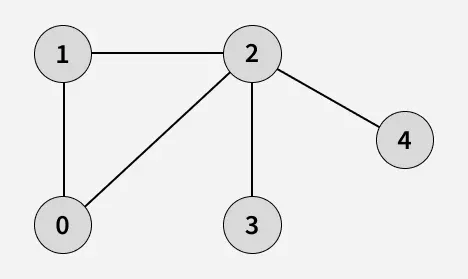
Input: adj[][] = [[1, 2], [0, 2], [0, 1, 3, 4], [2], [2]]
👁 frame_3148Output: [0, 1, 2, 3, 4]
Explanation: The source vertex is 0. We visit it first, then we visit its adjacent.
Start at 0: Mark as visited. Print 0.
Move to 1: Mark as visited. Print 1.
Move to 2: Mark as visited. Print 2.
Move to 3: Mark as visited. Print 3.(backtrack to 2)
Move to 4: Mark as visited. Print 4(backtrack to 2, then backtrack to 1, then to 0).Note that there can be more than one DFS Traversals of a Graph. For example, after 1, we may pick adjacent 2 instead of 0 and get a different DFS.
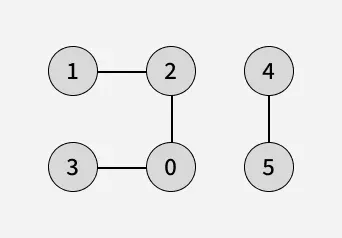
Input: adj[][] = [[2, 3], [2], [0, 1], [0], [5], [4]]
👁 420046859Output: [0, 2, 1, 3, 4, 5]
Explanation: DFS Steps:Start at 0: Mark as visited. Print 0.
Move to 2: Mark as visited. Print 2.
Move to 1: Mark as visited. Print 1 (backtrack to 2, then backtrack to 0).
Move to 3: Mark as visited. Print 3 (backtrack to 0).
Start with 4.
Start at 4: Mark as visited. Print 4.
Move to 5: Mark as visited. Print 5. (backtrack to 4)
Depth First Search (DFS) starts from a given source vertex and explores one path as deeply as possible. When it reaches a vertex with no unvisited neighbors, it backtracks to the previous vertex to explore other unvisited paths. This continues until all vertices reachable from the source are visited.
In a graph, there might be loops. So we use an extra visited array to make sure that we do not process a vertex again.
Let us understand the working of Depth First Search with the help of the following Illustration:
0 1 2 3 4
Time complexity: O(V + E), where V is the number of vertices and E is the number of edges in the graph.
Auxiliary Space: O(V + E), since an extra visited array of size V is required, And stack size for recursive calls to dfsRec function.
In a disconnected graph, some vertices may not be reachable from a single source. To ensure all vertices are visited in DFS traversal, we iterate through each vertex, and if a vertex is unvisited, we perform a DFS starting from that vertex being the source. This way, DFS explores every connected component of the graph.
Below if the implementation of DFS for a disconnected graph:
0 3 2 1 4 5
Time complexity: O(V + E). We visit every vertex at most once and every edge is traversed at most once (in directed) and twice in undirected.
Auxiliary Space: O(V + E), since an extra visited array of size V is required, and stack size for recursive calls of dfs function.