|
VOOZH | about |
|
VOOZH | about |
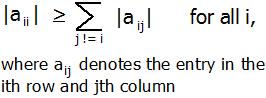
In mathematics, a square matrix is said to be diagonally dominant if for every row of the matrix, the magnitude of the diagonal entry in a row is larger than or equal to the sum of the magnitudes of all the other (non-diagonal) entries in that row. More precisely, the matrix A is diagonally dominant if
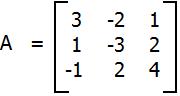
For example, The matrix
is diagonally dominant because
|a11| ? |a12| + |a13| since |+3| ? |-2| + |+1|
|a22| ? |a21| + |a23| since |-3| ? |+1| + |+2|
|a33| ? |a31| + |a32| since |+4| ? |-1| + |+2|
Given a matrix A of n rows and n columns. The task is to check whether matrix A is diagonally dominant or not.
Examples :
Input : A = { { 3, -2, 1 },
 { 1, -3, 2 },
 { -1, 2, 4 } };
Output : YES
Given matrix is diagonally dominant
because absolute value of every diagonal
element is more than sum of absolute values
of corresponding row.

Input : A = { { -2, 2, 1 },
 { 1, 3, 2 },
 { 1, -2, 0 } };
Output : NO
The idea is to run a loop from i = 0 to n-1 for the number of rows and for each row, run a loop j = 0 to n-1 find the sum of non-diagonal element i.e i != j. And check if diagonal element is greater than or equal to sum. If for any row, it is false, then return false or print "No". Else print "YES".
Implementation:
YES
Time Complexity: O(N2)
Auxiliary Space: O(1), since no extra space has been taken.