|
VOOZH | about |
|
VOOZH | about |
Given a weighted Graph and a source vertex, the task is to find the shortest paths from the source node to all other vertices.
Example:
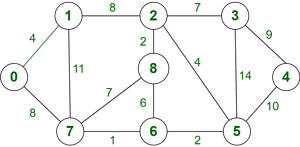
Input : n = 9, src = 0
👁 ImageOutput : 0 4 12 19 21 11 9 8 14
We have learned about how to find the shortest path from a given source vertex to all other vertex using Dijkstra's shortest path algorithm with the Time Complexity of O(E log V) in this article.
Can we optimize Dijkstra's shortest path algorithm to work better than O(E log V) if the maximum weight is small (or the range of edge weights is small)?
For example, in the above diagram, the maximum weight is 14. Many times the range of weights on edges is in a small range (i.e. all edge weights can be mapped to 0, 1, 2.. W where W is a small number). In that case, Dijkstra’s algorithm can be modified by using different data structures, and buckets, which is called dial implementation of Dijkstra's algorithm. time complexity is O(E + WV) where W is the maximum weight on any edge of the graph, so we can see that, if W is small then this implementation runs much faster than the traditional algorithm.
The following are important observations.
Approach:
The idea is to use bucket based optimization for Dijkstra's algorithm when edge weights are small integers. Instead of using a priority queue, we create buckets for each possible distance value and process nodes in distance order by iterating through buckets sequentially.
Step by step approach:
0 4 12 19 21 11 9 8 14
Time Complexity: O(V + E + W×V), where W is the maximum weight of an edge.
Space Complexity: O(V + W×V) for storing buckets and adjacency list.